
Beginner Investing Roadmap 2026: A Step-by-Step Plan for First-Time Investors
Follow this Beginner Investing Roadmap 2026 to learn exactly how to start investing, build confidence, avoid costly mistakes, and create a long-term wealth-building strategy.
Table of Contents
- Why Most Beginners Feel Overwhelmed
- What Is a Beginner Investing Roadmap?
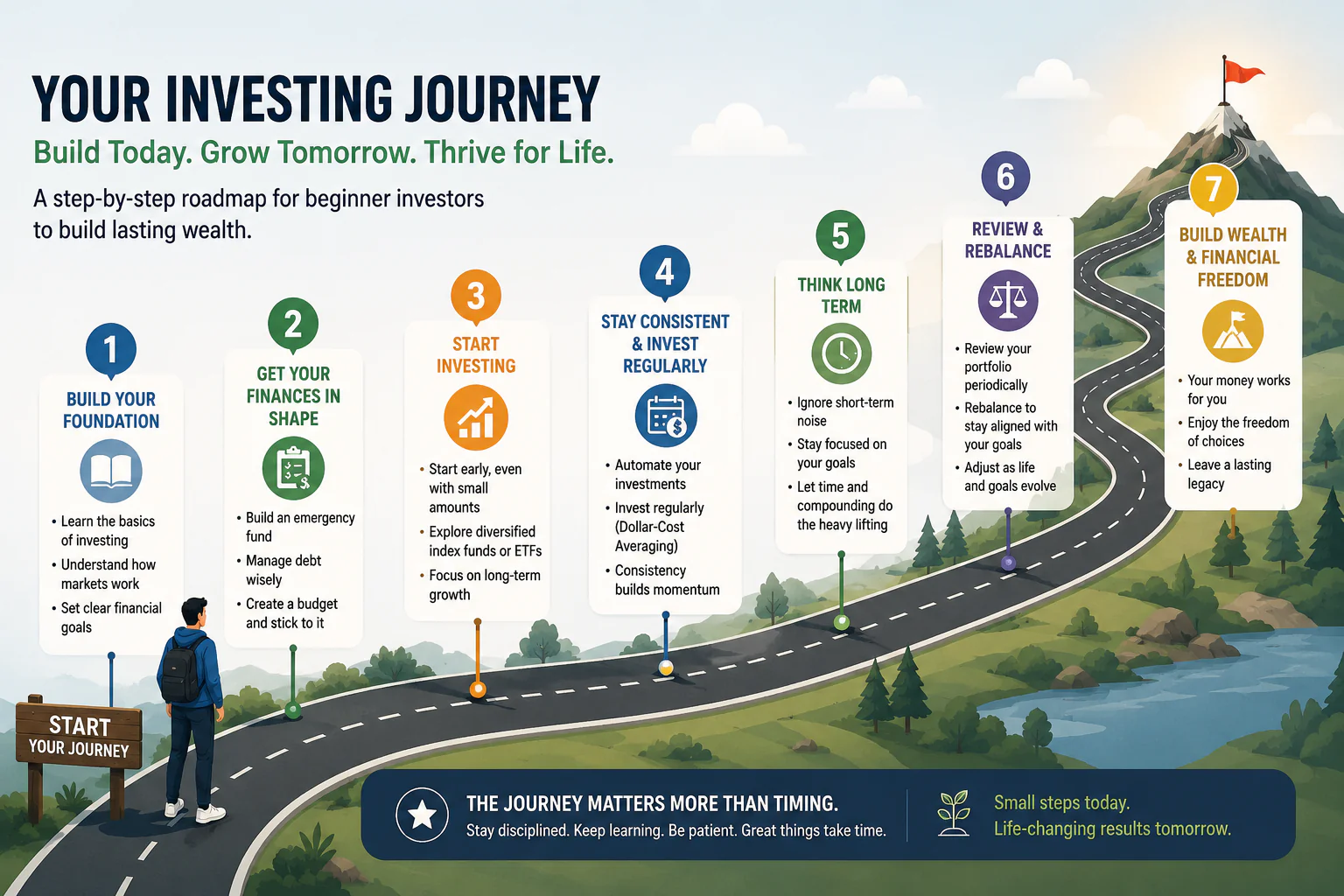
- The 7 Stages of the Investing Journey
- Stage 1: Build Your Financial Foundation
- Stage 2: Learn the Basics of Investing
- Stage 3: Define Your Financial Goals
- Why Following a Roadmap Matters
- Frequently Asked Questions
- Final Thoughts
Introduction
Starting your investing journey can feel overwhelming.
There are thousands of stocks, ETFs, investing strategies, financial influencers, and opinions competing for your attention every day.
Many beginner investors spend months consuming content but never take action.
Others rush into the market without understanding the fundamentals and end up making costly mistakes.
The good news is that successful investing doesn’t require genius-level intelligence or perfect timing.
It requires a clear roadmap.
This Beginner Investing Roadmap is designed to help first-time investors understand exactly what steps to take, in what order, and why each stage matters.
Think of it as your investing GPS.
Instead of wondering what to do next, you’ll have a structured path that guides you from complete beginner to confident long-term investor.
Why Most Beginners Feel Overwhelmed
One of the biggest challenges beginner investors face is information overload.
Today, investors have access to more information than ever before.
Unfortunately, more information does not always lead to better decisions.
Many beginners find themselves asking:
- Should I buy stocks?
- Should I invest in ETFs?
- Is now the right time?
- How much money do I need?
- Which platform should I use?
Without a structured process, investing can quickly become confusing.
The SEC Investor Education Center emphasizes the importance of learning foundational investing principles before making investment decisions.
A roadmap helps organize that learning process.
The Problem with Random Investing
Many investors begin their journey by copying what someone else is doing.
Examples include:
- Following social media influencers
- Buying trending stocks
- Chasing market hype
- Reacting to news headlines
This approach rarely leads to consistent long-term results.
Successful investing is usually built upon systems, not impulses.
What Is a Beginner Investing Roadmap?
A Beginner Investing Roadmap is a structured framework that helps new investors progress through the essential stages of investing.
Rather than focusing immediately on what to buy, a roadmap focuses on:
- Education
- Preparation
- Planning
- Strategy
- Execution
- Long-term discipline
The goal is to create a repeatable process that can support wealth building for years or even decades.
Why Roadmaps Work
Roadmaps provide clarity.
When investors know what step comes next, they are less likely to become distracted by short-term market noise.
They can focus on building a strong foundation instead of searching for shortcuts.
This aligns closely with the investing principles discussed throughout InvestSmartEdge.
The 7 Stages of the Investing Journey
Every successful investor follows a journey.
The specific investments may differ.
The sequence often remains surprisingly similar.
The seven stages are:
Stage 1: Build Your Financial Foundation
Stage 2: Learn the Basics of Investing
Stage 3: Define Your Financial Goals
Stage 4: Create Your Investment Strategy
Stage 5: Build Your First Portfolio
Stage 6: Stay Consistent
Stage 7: Build Long-Term Wealth
We’ll explore each stage in detail.
Stage 1: Build Your Financial Foundation
Before buying your first investment, you need a stable financial foundation.
Many investing mistakes occur because people try to invest before their finances are prepared.
FREE BEGINNER INVESTING STARTER KIT
No spam.
Create an Emergency Fund
An emergency fund acts as a financial safety net.
Unexpected events happen.
Examples include:
- Medical expenses
- Job loss
- Home repairs
- Family emergencies
Without an emergency fund, investors may be forced to sell investments at the worst possible time.
Manage High-Interest Debt
Before aggressively investing, consider reducing expensive debt.
Interest on debt can often outweigh investment returns.
Build Healthy Financial Habits
Successful investors often develop habits such as:
- Budgeting
- Saving consistently
- Tracking expenses
- Planning ahead
Stage 2: Learn the Basics of Investing
Investing becomes significantly easier once you understand a few core concepts.
Fortunately, you do not need a finance degree.
Learn What Stocks Are
Stocks represent ownership in companies.
When companies grow, shareholders may benefit.
Learn What ETFs Are
ETFs provide diversified exposure to multiple investments.
For many beginners, ETFs are an excellent starting point.
Understand Risk and Reward
Every investment involves risk.
Generally speaking:
Higher potential returns often involve higher risk.
Understanding this relationship is essential.
Before moving forward, we strongly recommend reading:
How the Stock Market Works
Stocks vs ETFs for Beginners
How Much Money to Start Investing
These articles provide the knowledge foundation every investor should possess.

Stage 3: Define Your Financial Goals
One of the biggest mistakes beginner investors make is investing without a clear destination.
Goals create direction.
Without goals, it becomes difficult to build an effective investment strategy.
Common Investing Goals
Examples include:
- Retirement
- Financial independence
- Buying a home
- Education funding
- Wealth building
Why Goals Matter
Your goals influence:
- Risk tolerance
- Investment choices
- Portfolio construction
- Time horizon
Different goals require different strategies.
Connect Goals to Action
A goal without a plan is merely a wish.
Successful investors translate goals into specific actions.
Examples:
- Monthly contributions
- Portfolio targets
- Savings milestones

Why Following a Roadmap Matters
A roadmap reduces confusion.
It provides structure.
Most importantly, it helps investors focus on the next logical step rather than trying to master everything at once.
By following a roadmap, beginner investors can:
✔ Build confidence
✔ Avoid common mistakes
✔ Reduce emotional investing
✔ Develop long-term discipline
✔ Create a sustainable wealth-building process
Stage 4: Create Your Investment Strategy
At this stage of the Beginner Investing Roadmap, you’ve already:
✔ Built a financial foundation
✔ Learned the investing basics
✔ Defined your financial goals
Now it’s time to create your investment strategy.
Many beginner investors mistakenly believe strategy means finding the best stock.
In reality, strategy is the framework that guides every investing decision you make.
Your strategy determines:
- How much risk you take
- What investments you choose
- How often you invest
- How you react to market volatility
- How you build wealth over time
Without a strategy, investing becomes reactive.
With a strategy, investing becomes intentional.
Why Strategy Matters More Than Stock Selection
A common beginner mistake is focusing exclusively on finding the next winning investment.
Experienced investors often focus more on:
- Diversification
- Asset allocation
- Consistency
- Risk management
than on predicting which stock will outperform next year.
As the SEC Investor Education Center frequently emphasizes, successful investing is often more about process than prediction.
The Four Foundations of a Strong Investment Strategy
Every successful strategy typically includes:
Diversification
Reducing risk by spreading investments across multiple assets.
Consistency
Investing regularly regardless of market conditions.
Long-Term Thinking
Allowing compounding and market growth to work over time.
Risk Management
Protecting your portfolio from unnecessary risk.
Stage 5: Build Your First Portfolio
Once a strategy exists, the next step is creating a portfolio.
A portfolio is simply the collection of investments you own.
The goal is not to build the perfect portfolio.
The goal is to build a portfolio that aligns with your goals and risk tolerance.
What Should Beginners Include?
For many first-time investors, a portfolio may include:
- Broad Market ETFs
- International ETFs
- Dividend ETFs
- Individual Stocks (optional)
Many successful investors start simple and gradually expand their portfolios over time.
The Power of Simplicity
One of the most common beginner mistakes is creating an overly complex portfolio.
More investments do not automatically create better results.
A simple portfolio is often:
- Easier to understand
- Easier to manage
- Easier to maintain
For a deeper explanation of portfolio construction, see:
Portfolio Diversification for Beginners
Understanding Diversification
Diversification is one of the most important concepts in investing.
It means spreading your money across different investments rather than relying on a single asset.
Why Diversification Works
Imagine investing everything in one company.
If that company struggles, your entire portfolio suffers.
Now imagine owning:
- Hundreds of companies
- Multiple sectors
- Multiple countries
Risk becomes more balanced.
This is one reason ETFs are so popular among beginner investors.
Diversification Across Asset Classes
Examples include:
Stocks
Potential growth.
Bonds
Potential stability.
Cash
Liquidity and flexibility.
International Investments
Global exposure.
Learn more:
Stocks vs ETFs for Beginners
FREE ETF BEGINNER BLUEPRINT
No spam.

Understanding Asset Allocation
Asset allocation refers to how your investments are distributed.
It helps determine both risk and potential returns.
Example Conservative Allocation
- Stocks: 40%
- Bonds: 50%
- Cash: 10%
Example Moderate Allocation
- Stocks: 70%
- Bonds: 20%
- Cash: 10%
Example Growth Allocation
- Stocks: 90%
- Cash: 10%
Why Asset Allocation Matters
Many investing experts believe asset allocation has a greater impact on long-term results than selecting individual investments.
This is because asset allocation influences:
- Volatility
- Risk exposure
- Portfolio stability
- Growth potential
The educational resources provided by Vanguard Investor Education (https://investor.vanguard.com/investor-resources-education) offer valuable guidance on building diversified portfolios.

Understanding Risk Management
Risk is a normal part of investing.
The goal is not to eliminate risk.
The goal is to manage it intelligently.
Common Risk Management Techniques
Diversification
Avoid excessive concentration.
Position Sizing
Avoid allocating too much money to a single investment.
Long-Term Thinking
Reduce emotional reactions to short-term volatility.
Emergency Fund
Maintain financial flexibility.
Why Risk Management Matters
Many investing losses occur not because markets decline, but because investors react emotionally.
Understanding risk helps investors remain disciplined during periods of uncertainty.
This concept connects closely with:
How to Build a Strong Investment Mindset Before You Start Investing
Beginner Portfolio Examples
The examples below are educational illustrations rather than personalized financial advice.
Example 1: Conservative Portfolio
| Asset Type | Allocation |
|---|---|
| Broad Market ETFs | 40% |
| Bond ETFs | 40% |
| Dividend ETFs | 10% |
| Cash | 10% |
Suitable for:
- Conservative investors
- Lower risk tolerance
Example 2: Moderate Portfolio
| Asset Type | Allocation |
| Broad Market ETFs | 50% |
| International ETFs | 20% |
| Individual Stocks | 20% |
| Bonds | 10% |
Suitable for:
- Most beginner investors
- Long-term wealth builders
Example 3: Growth Portfolio
| Asset Type | Allocation |
| Growth ETFs | 50% |
| Individual Stocks | 30% |
| International ETFs | 15% |
| Cash | 5% |
Suitable for:
- Younger investors
- Long-term growth objectives

From Learning to Investing
Many beginner investors spend months—or even years—learning.
Learning is valuable.
However, at some point, learning must be combined with action.
The objective is not perfection.
The objective is progress.
Small consistent steps often outperform waiting for the perfect moment.
As FINRA Investor Education frequently reminds investors, building a disciplined process is often more important than attempting to predict short-term market movements.
Stage 6: Stay Consistent
At this point in the Beginner Investing Roadmap, you’ve already:
✔ Built a financial foundation
✔ Learned investing fundamentals
✔ Defined your goals
✔ Created a strategy
✔ Built your first portfolio
Now comes the stage where most wealth is actually created:
Consistency.
Many investors believe success comes from making brilliant decisions.
In reality, success often comes from repeatedly making reasonable decisions over long periods of time.
Why Consistency Matters More Than Perfection
One of the biggest myths in investing is that you need to find the perfect investment.
The truth is:
Perfect investments rarely exist.
What matters more is consistently applying a sound strategy.
For example:
Investor A spends years searching for the perfect opportunity.
Investor B invests consistently every month.
Over time, Investor B often achieves better results because action compounds while hesitation does not.
The Power of Small Actions
Many beginner investors underestimate the impact of regular contributions.
Consider someone investing:
- $50 per month
- $100 per month
- $200 per month
These amounts may seem small initially.
However, consistency combined with time can produce significant results.
This principle forms the foundation of long-term wealth building.

The Power of Compound Growth
Albert Einstein is often credited with calling compound interest one of the most powerful forces in the world.
Whether or not the quote is authentic, the principle remains true.
Compounding allows investment growth to generate additional growth.
Over time, this creates a snowball effect.
What Is Compounding?
Compounding occurs when:
Investment Returns
↓
Generate Additional Returns
↓
Which Generate More Returns
↓
Repeated Over Time
The longer the process continues, the greater the potential impact.
Why Time Matters
Many people focus on:
- Starting with more money
Instead of:
- Starting earlier
Time is often the most valuable asset an investor possesses.
A person who starts investing at age 25 may have a significant advantage over someone who starts at age 40, even if the second person contributes more money initially.
Educational Resource
Investopedia provides excellent educational explanations regarding compound growth and long-term investing principles.

Dollar-Cost Averaging: The Secret Weapon of Beginner Investors
One of the most effective ways to stay consistent is through Dollar-Cost Averaging (DCA).
What Is Dollar-Cost Averaging?
Dollar-Cost Averaging means investing a fixed amount of money at regular intervals.
Examples:
- $100 every month
- $200 every two weeks
- $500 every quarter
Regardless of market conditions.
Why DCA Works
When prices are lower:
You buy more shares.
When prices are higher:
You buy fewer shares.
Over time, this can help smooth out the effects of market volatility.
Psychological Benefits
DCA also reduces emotional decision-making.
Instead of constantly asking:
“Is this the right time to invest?”
the process becomes automatic.
This helps investors remain disciplined.

Stage 7: Build Long-Term Wealth
The final stage of the Beginner Investing Roadmap is not a destination.
It is an ongoing process.
Building wealth rarely happens overnight.
Most successful investors spend years developing:
- Discipline
- Knowledge
- Patience
- Confidence
Wealth Building Is a Marathon
Modern media often promotes:
- Fast profits
- Overnight success
- Instant wealth
Reality is different.
Long-term wealth is usually built through:
- Consistency
- Diversification
- Compounding
- Time
Why Patience Matters
Markets naturally experience periods of:
- Growth
- Volatility
- Corrections
- Recovery
Investors who remain disciplined often benefit from staying focused on long-term objectives.
The educational resources available through Morningstar (https://www.morningstar.com) frequently highlight the importance of maintaining a long-term perspective.
The Mindset of Successful Investors
Successful investors tend to think differently.
They focus less on short-term predictions and more on long-term processes.
They Focus on What They Can Control
Examples include:
✔ Saving rate
✔ Investment contributions
✔ Diversification
✔ Risk management
✔ Education
They Ignore What They Cannot Control
Examples include:
✘ Daily market movements
✘ Economic headlines
✘ Market predictions
✘ Social media hype
For a deeper exploration of investing psychology, read:
How to Build a Strong Investment Mindset Before You Start Investing
Common Beginner Investing Mistakes
Avoiding mistakes can be just as important as making good decisions.
Mistake #1: Waiting Too Long
Many investors delay investing because they feel unprepared.
Unfortunately, waiting often carries its own cost.
Mistake #2: Chasing Trends
Following hype rarely creates sustainable wealth.
Mistake #3: Ignoring Diversification
Concentration increases risk unnecessarily.
Mistake #4: Panic Selling
Emotional reactions frequently lead to poor decisions.
Mistake #5: Constantly Changing Strategies
Successful investors typically remain committed to a long-term plan.
Mistake #6: Focusing Only on Returns
Risk management matters just as much as potential profits.
Building Investing Habits That Last a Lifetime
Investing success is often the result of habits rather than extraordinary decisions.
Examples of valuable habits include:
Monthly Investing
Contribute regularly.
Ongoing Education
Continue learning.
Periodic Portfolio Reviews
Monitor progress without becoming obsessed.
Goal Tracking
Measure advancement toward financial objectives.
Long-Term Thinking
Focus on decades rather than days.
The Beginner Investor Success Formula
The entire Beginner Investing Roadmap can be summarized in a simple formula:
Learn
↓
Plan
↓
Start
↓
Diversify
↓
Invest Consistently
↓
Stay Patient
↓
Build Wealth
Why This Roadmap Works
It transforms investing from a confusing collection of decisions into a structured process.
Instead of asking:
“Which stock should I buy today?”
You begin asking:
“What is the next step in my investing journey?”
This shift in thinking often separates successful investors from unsuccessful ones.
Your Complete Beginner Investing Action Plan
At this stage of the Beginner Investing Roadmap, you now understand:
✔ How investing works
✔ Why strategy matters
✔ The importance of diversification
✔ How to build a portfolio
✔ The power of consistency
✔ How long-term wealth is created
The next step is simple:
Take action.
Knowledge without action rarely produces results.
The goal is not perfection.
The goal is progress.
Your First-Year Investing Roadmap
Many beginner investors feel overwhelmed because they try to learn everything at once.
Instead, focus on progressing one step at a time.
Month 1: Build Your Foundation
Focus on:
- Creating a budget
- Tracking expenses
- Building an emergency fund
- Reducing high-interest debt
Goal:
Strengthen your financial foundation before investing aggressively.
Month 2: Learn the Fundamentals
Focus on understanding:
- Stocks
- ETFs
- Diversification
- Risk management
- Portfolio construction
Recommended Reading:
How the Stock Market Works
Stocks vs ETFs for Beginners
How Much Money to Start Investing
Month 3: Define Your Goals
Ask yourself:
- Why am I investing?
- What am I trying to achieve?
- What is my time horizon?
Examples:
- Retirement
- Financial freedom
- Wealth building
- Passive income
Month 4: Create Your Strategy
Develop a simple plan.
Determine:
- Monthly contribution amount
- Asset allocation
- Investment vehicles
- Review schedule
Remember:
Simple strategies often outperform complicated ones.
Month 5: Build Your First Portfolio
Begin implementing your strategy.
Many beginners start with:
- Broad Market ETFs
- International ETFs
- Dividend ETFs
The objective is not to build the perfect portfolio.
The objective is to begin.
Months 6–12: Stay Consistent
Focus on:
✔ Regular contributions
✔ Learning
✔ Reviewing progress
✔ Avoiding emotional decisions
✔ Staying patient
This is where long-term wealth building truly begins.

What Success Looks Like After One Year
Many people assume investing success is measured by returns.
In reality, successful first-year investors often achieve something more important:
They build a system.
After one year, successful beginner investors typically have:
✔ An emergency fund
✔ A clear investing strategy
✔ A diversified portfolio
✔ Consistent investing habits
✔ Greater financial confidence
These achievements create the foundation for future wealth.
The InvestSmartEdge Beginner Investor Framework
Throughout this Beginner Investing Roadmap, we’ve developed a simple framework that can guide investors for years.
Step 1
Learn the Basics
↓
Step 2
Build a Financial Foundation
↓
Step 3
Define Financial Goals
↓
Step 4
Create an Investment Strategy
↓
Step 5
Build a Diversified Portfolio
↓
Step 6
Invest Consistently
↓
Step 7
Stay Patient
↓
Step 8
Build Long-Term Wealth
This framework reflects the core philosophy of InvestSmartEdge:
Helping Beginner Investors Build Wealth Through Education, Strategy, Psychology, and Smart Investing Tools.
Tools That Can Help You Along the Way
Modern investors have access to powerful tools that can simplify research and decision-making.
TradingView
Best for:
Chart analysis and market monitoring.
Read:
TradingView Review 2026
Finviz
Best for:
Finding investment opportunities.
Read:
Finviz Review 2026
TrendSpider
Best for:
Automating market analysis.
Read:
TrendSpider Review 2026
AI Investing Tools
Explore:
Best AI Tools for Beginner Investors
FREE AI INVESTOR TOOLKIT
No spam.

FAQ
What is the best way to start investing as a beginner?
The best approach is to build a financial foundation, learn the basics, create a strategy, and start investing consistently with a diversified portfolio.
How much money do I need to start investing?
Many investment platforms allow investors to begin with relatively small amounts. Consistency is generally more important than the starting amount.
Should beginners invest in stocks or ETFs?
For most beginners, ETFs provide a simpler and more diversified starting point.
How often should I invest?
Many investors use monthly contributions because they support consistency and Dollar-Cost Averaging.
How long does it take to build wealth through investing?
Wealth building is usually a long-term process measured in years or decades rather than months.
What is the biggest mistake beginner investors make?
One of the most common mistakes is delaying action while waiting for perfect conditions.
Can beginner investors use AI tools?
Yes. Tools such as TradingView, Finviz, TrendSpider, ChatGPT, and other research platforms can help investors learn and analyze opportunities more efficiently.
What should I do after completing this roadmap?
The next step is expanding your knowledge through more advanced topics such as portfolio diversification, investment strategies, investing psychology, and wealth building.
Final Thoughts
The investing journey can feel intimidating at first.
However, successful investing is rarely about predicting the future.
It is about building a process.
The Beginner Investing Roadmap provides a structured path that helps investors move from uncertainty to confidence.
You do not need to know everything before you begin.
You simply need to take the next logical step.
Over time, those small steps can become significant financial progress.
Remember:
Successful investors are not necessarily the smartest people in the market.
They are often the most disciplined.
Learn consistently.
Invest consistently.
Stay patient.
And allow time to work in your favor.
Want More Beginner Investing Guides?
Join the InvestSmartEdge newsletter and receive:
✔ Beginner investing education
✔ Wealth-building strategies
✔ Investment tools and reviews
✔ Market insights
✔ Investing psychology tips
✔ Long-term investing guidance
directly in your inbox.
START BUILDING WEALTH WITH CONFIDENCE
No spam.
Author:
Mario Cazombo
Mario Cazombo is the founder of InvestSmartEdge and a financial education writer dedicated to helping beginner investors build wealth through investing education, strategic thinking, investor psychology, and smart investing tools.
His mission is to make investing simpler, more accessible, and easier to understand for investors at every stage of their journey.