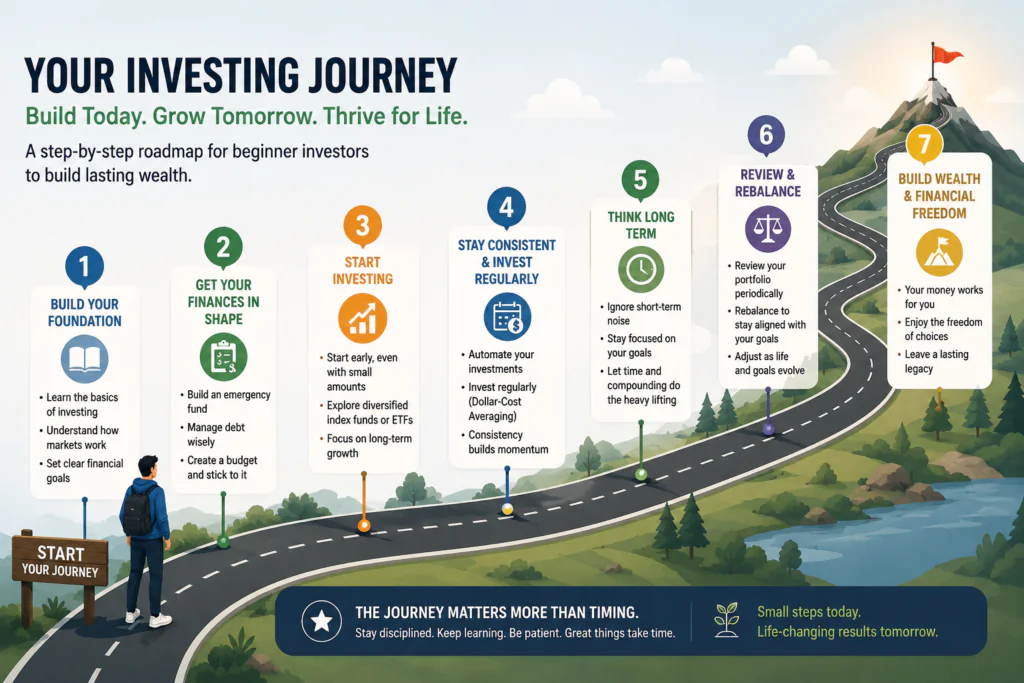

How to Invest in ETFs for Beginners in 2026
Introduction
If you’re new to investing, you’ve probably asked yourself a few important questions:
- Where should I start?
- How much money do I need?
- Should I buy individual stocks?
- What if I make a mistake?
The good news is that investing has become much more accessible than it was a decade ago. Today, beginner investors have access to powerful tools, educational resources, and investment products that can help them start building wealth without needing thousands of dollars or years of experience.
One investment option stands out as a favorite among both beginners and experienced investors: Exchange-Traded Funds, commonly known as ETFs.
Learning how to invest in ETFs for beginners is one of the smartest ways to start your investing journey. ETFs offer diversification, simplicity, affordability, and flexibility, making them an excellent choice for people who want to grow their wealth over the long term without spending hours researching individual stocks.
Instead of trying to pick winning companies, an ETF allows you to invest in a collection of assets through a single investment. This helps reduce risk while providing exposure to broad areas of the market.
Whether your goal is retirement, financial independence, passive income, or simply growing your savings faster than inflation, ETFs can play an important role in your investment strategy.
In this guide, you’ll learn:
- What ETFs are and how they work
- Why ETFs are ideal for beginner investors
- How to choose your first ETF
- How to build a diversified ETF portfolio
- Common mistakes to avoid
- A practical step-by-step process to start investing with confidence
By the end of this guide, you’ll have a clear understanding of how to invest in ETFs for beginners and how to use them as a foundation for long-term wealth building.
Table of Contents
1. What Is an ETF?
2. Why ETFs Are Popular Among Beginner Investors
3. How ETFs Work
4. Different Types of ETFs
5. Benefits of Investing in ETFs
6. Potential Risks of ETF Investing
7. How to Choose Your First ETF
8. How to Build Your First ETF Portfolio
9. Common ETF Investing Mistakes
10. Frequently Asked Questions
11. Final Thoughts
What Is an ETF?
An ETF, or Exchange-Traded Fund, is an investment fund that holds a collection of assets and trades on a stock exchange just like an individual stock.
Think of an ETF as a basket.
Instead of buying one company, you buy a basket that may contain dozens, hundreds, or even thousands of different investments.
For example, a broad market ETF may hold shares in some of the largest companies in the world across multiple sectors and industries.
When you buy a single share of that ETF, you instantly gain exposure to all of those companies.
This is one of the main reasons why ETFs have become so popular among investors.
How ETFs Work
ETFs are designed to track a specific index, sector, theme, or asset class.
Examples include:
- S&P 500 ETFs
- Total Stock Market ETFs
- International ETFs
- Bond ETFs
- Dividend ETFs
Rather than trying to outperform the market, many ETFs simply aim to mirror the performance of a specific market index.
This approach often leads to lower fees and greater transparency.
For beginner investors, this means you can participate in the growth of the broader market without needing to select individual stocks yourself.
Why ETFs Have Become So Popular
ETFs have grown rapidly because they combine several advantages into a single investment product.
They offer:
- Diversification
- Low costs
- Transparency
- Flexibility
- Ease of access
Investors can buy and sell ETFs throughout the trading day just like stocks, while still benefiting from the diversification typically associated with mutual funds.
ETF vs Mutual Fund
Many beginners confuse ETFs and mutual funds.
While both provide diversification, there are some key differences.
| Feature | ETF | Mutual Fund |
|---|---|---|
| Trades During Market Hours | Yes | No |
| Typically Lower Fees | Often | Sometimes |
| Real-Time Pricing | Yes | No |
| Minimum Investment | Usually Low | Can Be Higher |
For many beginner investors, ETFs provide a simple and cost-effective entry point into investing.
Read next:

Why ETFs Are Great for Beginners
When people first learn about investing, they often assume they need to identify the next big stock winner.
In reality, many successful investors achieve excellent results by focusing on diversification and consistency rather than trying to predict which company will outperform.
This is where ETFs truly shine.
Diversification Made Simple
Diversification is one of the most important concepts in investing.
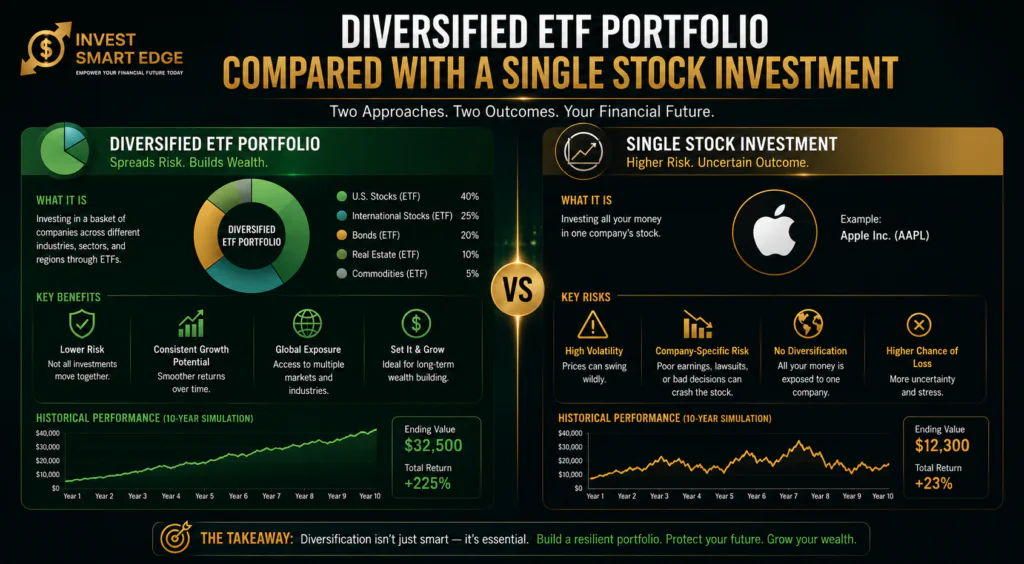
Instead of placing all your money into one company, ETFs allow you to spread your investment across many companies.
This helps reduce the impact of poor performance from any single investment.
For example, an S&P 500 ETF gives investors exposure to hundreds of leading U.S. companies through one purchase.
This level of diversification would be difficult and expensive to achieve by buying individual stocks separately.
Lower Risk Than Individual Stocks
Every company faces risks.
Management mistakes, competition, economic downturns, and changing consumer behavior can all impact performance.
When you invest in a single stock, you are exposed to the risks of that specific company.
When you invest in an ETF, those risks are spread across many holdings.
While ETFs still carry market risk, they generally reduce company-specific risk.
Lower Costs
Another major advantage of ETFs is cost efficiency.
Most broad-market ETFs charge relatively low expense ratios compared to actively managed investment funds.
Lower costs mean more of your money remains invested and working for you over time.
This may seem like a small detail, but fees can have a significant impact on long-term returns.
Accessibility for New Investors
Many investment platforms allow investors to purchase ETFs with relatively small amounts of money.
Some platforms even support fractional investing.
This means beginners can start investing without needing large amounts of capital.
Ideal for Long-Term Wealth Building
Perhaps the biggest reason ETFs are popular among beginners is their suitability for long-term investing.
Instead of constantly buying and selling investments, many investors use ETFs as the foundation of a long-term strategy built around:
- Diversification
- Consistency
- Patience
- Compound growth
These principles have helped countless investors build wealth over time.
Read next:
Stocks vs ETFs for Beginners: Which Investment Is Right for You?
Join the InvestSmartEdge Newsletter
Want more beginner-friendly investing guides, ETF strategies, wealth-building insights, and practical financial education?
Join the InvestSmartEdge newsletter and get actionable investing content designed to help you make smarter financial decisions and build long-term wealth.
Step 1: Define Your Investment Goals
Before buying your first ETF, it’s important to understand why you’re investing in the first place.
Many beginners jump into investing without a clear objective. This often leads to poor decisions, unrealistic expectations, and emotional reactions during market fluctuations.
Your investment goals will influence:
- The ETFs you choose
- Your risk tolerance
- Your investment timeline
- Your overall strategy
Retirement Goals
One of the most common reasons people invest is to build wealth for retirement.
Retirement investing typically involves a long time horizon, which allows investors to benefit from compound growth and ride out short-term market volatility.
For long-term retirement goals, many investors focus on diversified stock market ETFs.
Wealth Building Goals
Some investors simply want to grow their net worth over time.
Whether you’re saving for a home, your children’s education, or future opportunities, ETFs can provide a structured approach to long-term wealth accumulation.
Financial Independence Goals
Many investors pursue financial independence, which means building enough assets to generate income and support their desired lifestyle.
ETFs can play an important role in a financial independence strategy because they offer diversification and scalability.
Understanding Your Time Horizon
Your time horizon refers to how long you expect to keep your money invested before needing it.
General guidelines include:
| Goal | Time Horizon |
|---|---|
| Emergency Fund | Not suitable for ETFs |
| Home Purchase | 1–5 Years |
| Education Savings | 5–10 Years |
| Retirement | 10–40+ Years |
| Financial Independence | Long-Term |
The longer your investment horizon, the more time your investments have to recover from market downturns and benefit from compounding.
Read next:
Beginner Investing Roadmap 2026: A Step-by-Step Plan for First-Time Investors
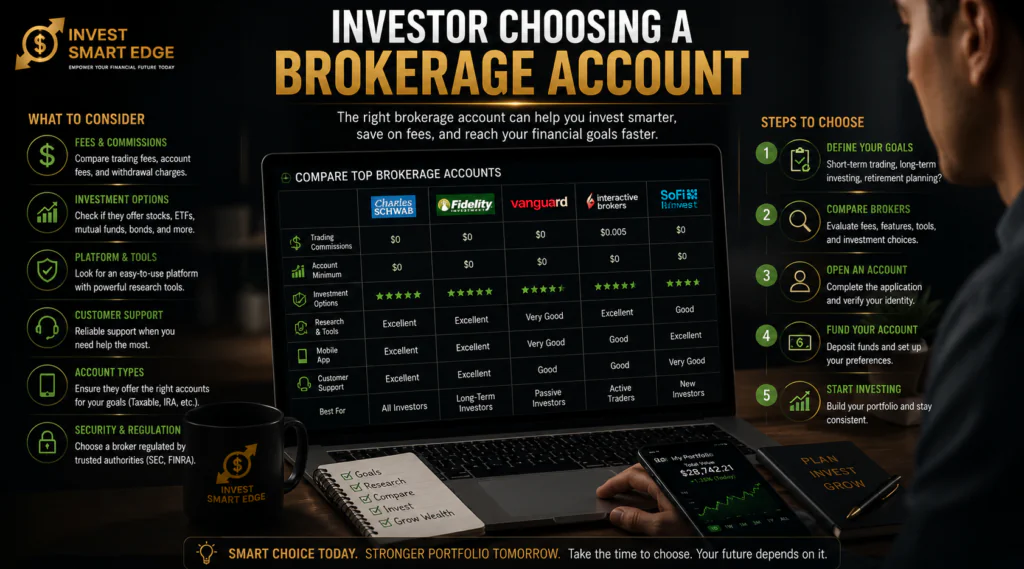
Step 2: Choose the Right Brokerage Account
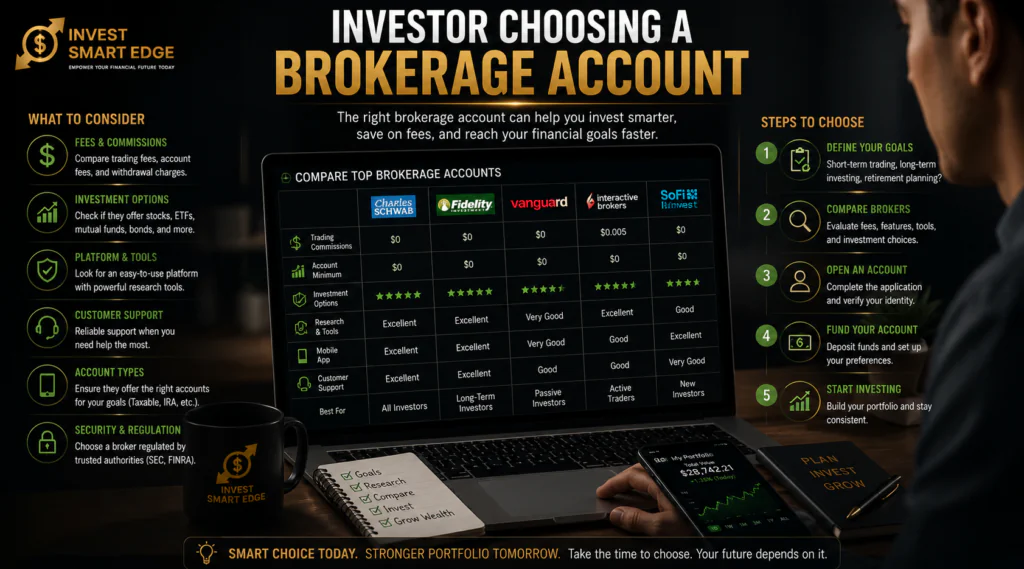
Once you’ve defined your goals, the next step is choosing a brokerage account.
A brokerage account is the platform that allows you to buy, sell, and manage investments.
Think of it as your gateway to the financial markets.
What to Look for in a Brokerage
Not all brokers are created equal.
When evaluating a brokerage platform, consider:
- Security
- Regulation
- Fees
- Ease of use
- Educational resources
- Investment selection
A beginner-friendly platform should make investing simple and transparent.
Understanding Fees
Although many brokers now offer commission-free trading, investors should still pay attention to:
- Account fees
- ETF expense ratios
- Withdrawal fees
- Currency conversion fees
Even small fees can affect long-term returns.
Security and Regulation
Always choose a broker regulated by recognized financial authorities.
A regulated brokerage provides greater transparency and investor protection.
User Experience Matters
As a beginner investor, simplicity matters.
A clean dashboard, educational content, and intuitive navigation can make your investing experience much easier.
Helpful educational resources:
- U.S. Securities and Exchange Commission (SEC)
- FINRA Investor Education
- Vanguard Investor Education Center
Read next:
How to Start Investing in 2026
Step 3: Learn the Different Types of ETFs
One of the biggest mistakes beginners make is assuming that all ETFs are the same.
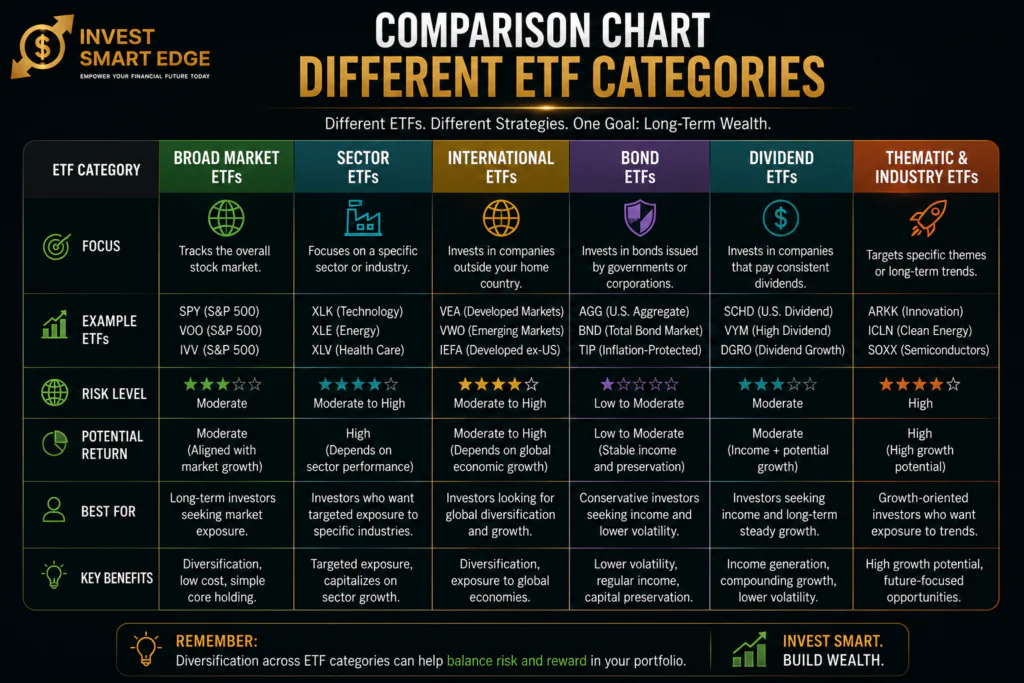
In reality, ETFs come in many different forms.
Understanding these categories helps you choose investments that align with your goals and risk tolerance.
Broad Market ETFs
Broad market ETFs track large portions of the stock market.
Examples include ETFs that follow:
- The S&P 500
- Total U.S. Stock Market
- Global Equity Markets
These ETFs are often recommended for beginners because they provide instant diversification.
International ETFs
International ETFs allow investors to gain exposure to companies outside their home country.
Benefits include:
- Geographic diversification
- Access to global growth opportunities
- Reduced dependence on one economy
Dividend ETFs
Dividend ETFs focus on companies that regularly distribute dividends to shareholders.
These ETFs can appeal to investors seeking:
- Income generation
- Stability
- Long-term dividend growth
Bond ETFs
Bond ETFs invest in fixed-income securities.
They are often used to:
- Reduce portfolio volatility
- Generate income
- Balance stock market exposure
Sector ETFs
Sector ETFs focus on specific industries, such as:
- Technology
- Healthcare
- Financial Services
- Energy
While they can offer strong growth potential, they generally carry higher concentration risk than broad market ETFs.
Which ETF Type Is Best for Beginners?
For most beginner investors, broad market ETFs often provide the simplest and most effective starting point.
They offer:
✔ Diversification
✔ Lower risk compared to individual stocks
✔ Low maintenance
✔ Long-term growth potential
As your investing knowledge grows, you can gradually explore additional ETF categories.
Coming Soon:
How to Choose Your First ETF
Join the InvestSmartEdge Newsletter
Want more beginner-friendly investing guides, ETF strategies, wealth-building insights, and practical financial education?
Join the InvestSmartEdge newsletter and get actionable investing content designed to help you make smarter financial decisions and build long-term wealth.
Step 1: Define Your Investment Goals
Before buying your first ETF, it’s important to understand why you’re investing in the first place.
Many beginners jump into investing without a clear objective. This often leads to poor decisions, unrealistic expectations, and emotional reactions during market fluctuations.
Your investment goals will influence:
- The ETFs you choose
- Your risk tolerance
- Your investment timeline
- Your overall strategy
Retirement Goals
One of the most common reasons people invest is to build wealth for retirement.
Retirement investing typically involves a long time horizon, which allows investors to benefit from compound growth and ride out short-term market volatility.
For long-term retirement goals, many investors focus on diversified stock market ETFs.
Wealth Building Goals
Some investors simply want to grow their net worth over time.
Whether you’re saving for a home, your children’s education, or future opportunities, ETFs can provide a structured approach to long-term wealth accumulation.
Financial Independence Goals
Many investors pursue financial independence, which means building enough assets to generate income and support their desired lifestyle.
ETFs can play an important role in a financial independence strategy because they offer diversification and scalability.
Understanding Your Time Horizon
Your time horizon refers to how long you expect to keep your money invested before needing it.
General guidelines include:
| Goal | Time Horizon |
|---|---|
| Emergency Fund | Not suitable for ETFs |
| Home Purchase | 1–5 Years |
| Education Savings | 5–10 Years |
| Retirement | 10–40+ Years |
| Financial Independence | Long-Term |
The longer your investment horizon, the more time your investments have to recover from market downturns and benefit from compounding.
Read next:
Beginner Investing Roadmap 2026: A Step-by-Step Plan for First-Time Investors
Step 2: Choose the Right Brokerage Account
Once you’ve defined your goals, the next step is choosing a brokerage account.
A brokerage account is the platform that allows you to buy, sell, and manage investments.
Think of it as your gateway to the financial markets.
What to Look for in a Brokerage
Not all brokers are created equal.
When evaluating a brokerage platform, consider:
- Security
- Regulation
- Fees
- Ease of use
- Educational resources
- Investment selection
A beginner-friendly platform should make investing simple and transparent.
Understanding Fees
Although many brokers now offer commission-free trading, investors should still pay attention to:
- Account fees
- ETF expense ratios
- Withdrawal fees
- Currency conversion fees
Even small fees can affect long-term returns.
Security and Regulation
Always choose a broker regulated by recognized financial authorities.
A regulated brokerage provides greater transparency and investor protection.
User Experience Matters
As a beginner investor, simplicity matters.
A clean dashboard, educational content, and intuitive navigation can make your investing experience much easier.
Helpful educational resources:
- U.S. Securities and Exchange Commission (SEC)
- FINRA Investor Education
- Vanguard Investor Education Center
Read next:
How to Start Investing in 2026
Step 3: Learn the Different Types of ETFs
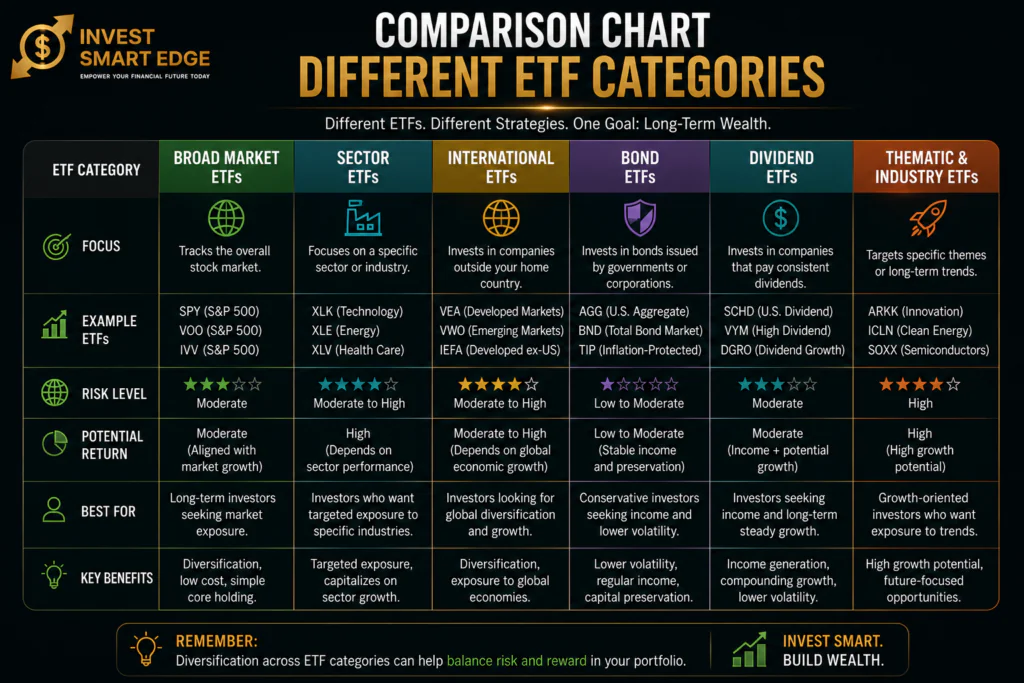
One of the biggest mistakes beginners make is assuming that all ETFs are the same.
In reality, ETFs come in many different forms.
Understanding these categories helps you choose investments that align with your goals and risk tolerance.
Broad Market ETFs
Broad market ETFs track large portions of the stock market.
Examples include ETFs that follow:
- The S&P 500
- Total U.S. Stock Market
- Global Equity Markets
These ETFs are often recommended for beginners because they provide instant diversification.
International ETFs
International ETFs allow investors to gain exposure to companies outside their home country.
Benefits include:
- Geographic diversification
- Access to global growth opportunities
- Reduced dependence on one economy
Dividend ETFs
Dividend ETFs focus on companies that regularly distribute dividends to shareholders.
These ETFs can appeal to investors seeking:
- Income generation
- Stability
- Long-term dividend growth
Bond ETFs
Bond ETFs invest in fixed-income securities.
They are often used to:
- Reduce portfolio volatility
- Generate income
- Balance stock market exposure
Sector ETFs
Sector ETFs focus on specific industries, such as:
- Technology
- Healthcare
- Financial Services
- Energy
While they can offer strong growth potential, they generally carry higher concentration risk than broad market ETFs.
Which ETF Type Is Best for Beginners?
For most beginner investors, broad market ETFs often provide the simplest and most effective starting point.
They offer:
✔ Diversification
✔ Lower risk compared to individual stocks
✔ Low maintenance
✔ Long-term growth potential
As your investing knowledge grows, you can gradually explore additional ETF categories.
Coming Soon:
How to Choose Your First ETF
FAQ
What is the best ETF for beginners?
There is no single “best” ETF for everyone. However, many beginner investors start with broad-market ETFs that provide exposure to hundreds of companies across multiple sectors. These ETFs typically offer diversification, low costs, and long-term growth potential.
How much money do I need to start investing in ETFs?
Many brokerages allow investors to start with as little as $10 to $100 through fractional investing. The most important factor is starting early and investing consistently rather than waiting until you have a large amount of money.
Are ETFs safer than individual stocks?
ETFs are generally considered less risky than individual stocks because they provide diversification across many holdings. While ETFs can still lose value during market downturns, they reduce company-specific risk.
Can beginners build wealth using ETFs?
Yes. Many successful long-term investors use ETFs as the foundation of their portfolios. Consistent investing, diversification, and patience can help beginners build significant wealth over time.
How often should I invest in ETFs?
Many investors choose to invest monthly using a strategy called Dollar-Cost Averaging (DCA). This approach helps reduce the impact of market volatility and encourages disciplined investing.
What are the risks of ETF investing?
The primary risks include market risk, sector concentration risk, and economic downturns. However, broadly diversified ETFs generally help reduce risks compared to investing in individual stocks.
Should I invest in one ETF or multiple ETFs?
A single broad-market ETF may be sufficient for some beginners. As your portfolio grows, adding international ETFs or bond ETFs can help improve diversification.
Are ETFs good for long-term investing?
Yes. ETFs are widely used for long-term investing because they provide diversification, low costs, and exposure to long-term market growth.
Final Thoughts
Learning how to invest in ETFs for beginners is one of the smartest financial decisions you can make.
ETFs offer a simple and effective way to participate in the growth of the financial markets without needing to become an expert stock picker.
By following the steps outlined in this guide, you can:
- Define clear financial goals
- Choose the right brokerage account
- Understand different ETF types
- Select your first ETF confidently
- Build a diversified portfolio
- Avoid common investing mistakes
- Develop a long-term investing mindset
Remember that successful investing is not about finding the perfect investment.
It is about staying consistent, remaining patient, and allowing time and compounding to work in your favor.
The sooner you start, the more time your investments have to grow.
Even small investments made regularly can lead to meaningful results over the long term.
The best time to start investing was years ago.
The second-best time is today.
Join the InvestSmartEdge Newsletter
Want more beginner-friendly investing guides, ETF strategies, wealth-building insights, and practical financial education?
Join the InvestSmartEdge newsletter and get actionable investing content designed to help you make smarter financial decisions and build long-term wealth.
Author:
Mario Cazombo
Mario Cazombo is the founder of InvestSmartEdge, a financial education platform dedicated to helping beginner investors build wealth through education, strategy, psychology, and smart investing tools.
His mission is to simplify investing concepts and provide practical guidance that helps readers make informed financial decisions with confidence.
Disclaimer
Invest Smart Edge provides educational content for informational purposes only and does not provide investment, legal, tax, or financial advice.
Artificial intelligence tools should be used for educational and research purposes only. No AI platform can guarantee investment success or predict future market performance.
All investments involve risk, including the possible loss of principal. Past performance does not guarantee future results.
Always conduct your own research and consider consulting a qualified financial professional before making investment decisions.
Related Articles
Continue your investing journey with these beginner-friendly guides:
- How to Start Investing in 2026
- Investment Basics Every Beginner Must Know (Coming Soon)
- Beginner Investing Roadmap 2026
- How to Invest in Stocks for Beginners (Coming Soon)
- How to Build Your First Investment Portfolio (Coming Soon)
- Portfolio Diversification for Beginners
- Investment Guide 2026
- How to Build a Strong Investment Mindset Before You Start Investing
- 10 Smart Ways You Can Build Wealth in Today’s Economy
- Best AI Tools for Beginner Investors