
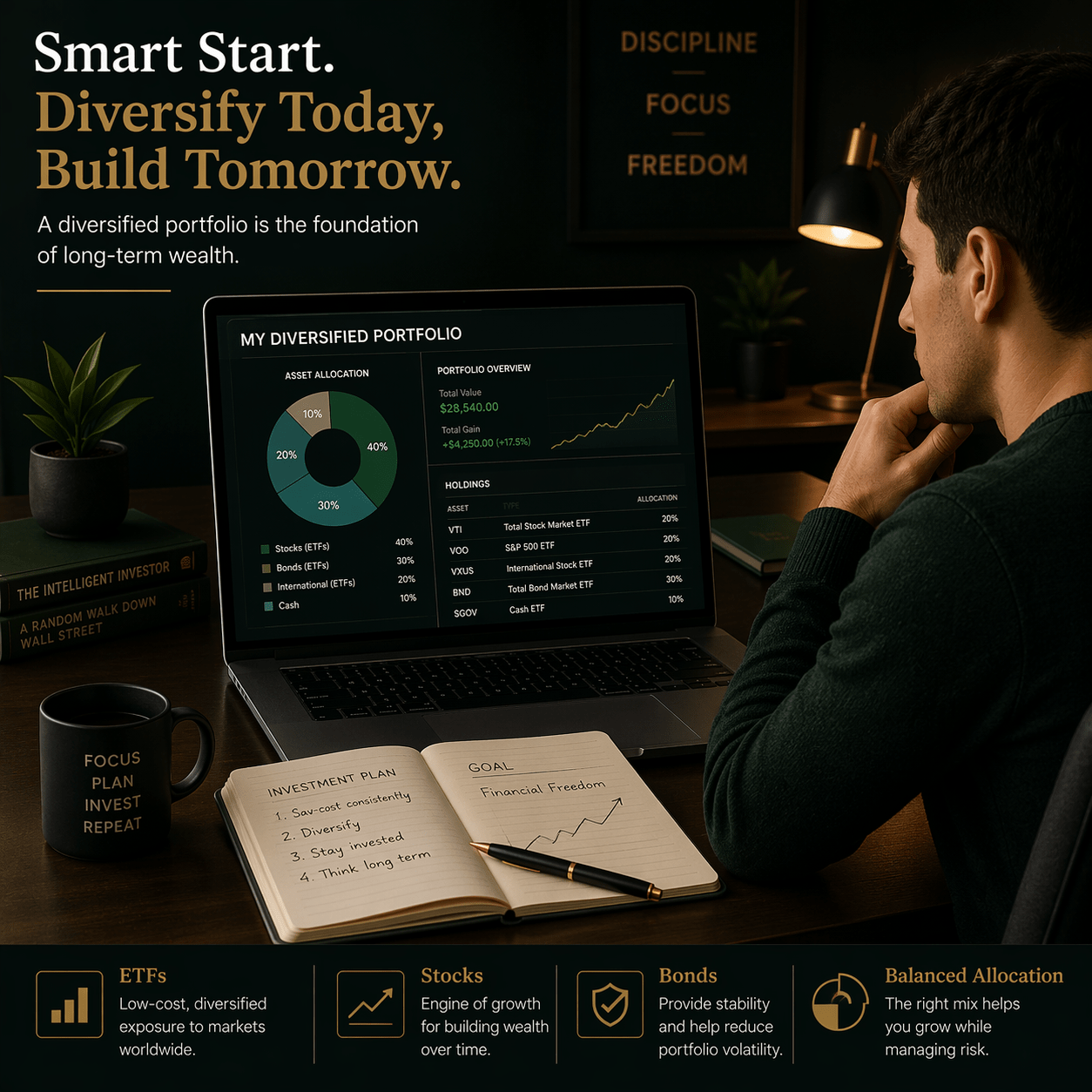
How to Build Your First Investment Portfolio | Beginner Portfolio Guide 2026
Learn how to build your first investment portfolio with 9 proven strategies for beginners. Discover diversification, asset allocation, ETFs, and long-term investing principles.
Introduction
Learning how to build your first investment portfolio can feel overwhelming.
There are thousands of stocks, ETFs, mutual funds, bonds, and investing strategies competing for your attention. As a beginner, it’s easy to believe you need expert knowledge before getting started.
The reality is much simpler.
Successful investing is rarely about finding the next hot stock or perfectly timing the market. Instead, long-term wealth is typically built through diversification, consistency, patience, and a well-structured investment portfolio.
Think of your investment portfolio as the foundation of your financial future. Just like a house needs a strong foundation to withstand storms, your portfolio needs a solid structure to handle market ups and downs.
In this guide, you’ll learn exactly how to build your first investment portfolio, how diversification works, how to choose the right investments, and how to create a portfolio that aligns with your goals and risk tolerance.
Whether you’re investing your first $100 or preparing to invest several thousand dollars, these principles can help you build a portfolio with confidence.
Table of Contents
- What Is an Investment Portfolio?
- Why Your Portfolio Matters More Than Individual Investments
- The Four Core Building Blocks of a Beginner Portfolio
- Understanding Risk and Return
- How Asset Allocation Works
- 9 Proven Strategies for Building Your First Portfolio
- Sample Beginner Investment Portfolios
- Common Portfolio Mistakes to Avoid
- Frequently Asked Questions
- Final Thoughts
Quick Summary
In This Guide You’ll Learn:
✔ What an investment portfolio actually is
✔ Why portfolio construction matters more than stock picking
✔ The four major building blocks of a beginner portfolio
✔ How asset allocation helps manage risk
✔ How to diversify effectively
✔ Nine proven portfolio-building strategies
✔ How long-term investors think about portfolio growth
✔ Common mistakes that can harm investment results
⏱ Estimated Reading Time: 20–25 Minutes
What Is an Investment Portfolio?
An investment portfolio is simply the collection of investments that you own.
These investments can include:
- Stocks
- ETFs (Exchange-Traded Funds)
- Bonds
- Mutual Funds
- REITs (Real Estate Investment Trusts)
- Cash and cash equivalents
Think of your portfolio like a sports team.
A championship team does not rely on just one player. It combines players with different strengths who work together toward a common goal.
Your portfolio should work the same way.
Instead of relying on a single stock or a single investment idea, a portfolio combines different assets that help balance growth opportunities and risk.
For example, a beginner investor might own:
- A Total Stock Market ETF
- An International ETF
- A Bond ETF
- A Small cash reserve
Together, these investments create a portfolio designed to support long-term financial goals.
The purpose of a portfolio is not to maximize gains every year.
The purpose is to create a structure that helps you stay invested while steadily building wealth over time.
According to the U.S. Securities and Exchange Commission (SEC), diversification and understanding investment risk are fundamental principles that every investor should understand before building a portfolio.
Why Your Portfolio Matters More Than Individual Investments
One of the biggest mistakes new investors make is focusing exclusively on stock picks.
They spend countless hours trying to find:
- The next Apple
- The next Nvidia
- The next Amazon
While stock selection matters, research consistently shows that portfolio construction often has a much larger impact on long-term investment outcomes.
Imagine two investors:
Investor A
Invests in a few popular stocks.
Investor B
Builds a diversified portfolio using broad-market ETFs, maintains discipline, and invests consistently.
Over long periods, Investor B often experiences:
- Lower volatility
- Better risk management
- Reduced emotional decision-making
- More consistent results
This is why experienced investors spend so much time thinking about portfolio structure.
A strong portfolio can help you:
- Manage risk
- Reduce stress
- Stay invested during downturns
- Focus on long-term goals
- Build wealth more consistently
Before worrying about finding the perfect investment, focus on building the right portfolio.
“If you’re still setting up your investing foundation, our guide on How to Start Investing in 2026 can help you understand the essential first steps before building a portfolio.”
The Four Core Building Blocks of a Beginner Portfolio
Every portfolio is built using a combination of investment types.
Understanding these building blocks makes portfolio construction much easier.
Stocks
Stocks represent ownership in a company.
When you buy a stock, you become a shareholder.
Historically, stocks have offered some of the strongest long-term growth opportunities available to investors.
However, they can also experience significant short-term volatility.
For this reason, most beginners should avoid concentrating their portfolio in just a handful of stocks.
ETFs
Exchange-Traded Funds (ETFs) are among the most beginner-friendly investment vehicles available.
An ETF can provide exposure to:
- Hundreds of companies
- Multiple sectors
- Entire countries
- Entire stock markets
Instead of buying 500 individual stocks, an investor can buy a single ETF that tracks the S&P 500.
This is one reason ETFs have become extremely popular among long-term investors.
ETF investing has grown significantly because investors can access broad diversification at relatively low cost. BlackRock’s iShares and Vanguard both provide educational resources explaining how ETFs can fit into long-term investment portfolios.
“For a deeper explanation of how ETFs work, see our complete guide on How to Invest in ETFs for Beginners.”
Bonds
Bonds are generally considered lower-risk investments compared to stocks.
When you buy a bond, you’re essentially lending money to a government or corporation in exchange for interest payments.
Bonds can help:
- Reduce portfolio volatility
- Provide stability
- Preserve capital
Investor.gov explains that bonds can serve as an important portfolio diversification tool because they often behave differently than stocks during various market conditions.
Many investors increase bond exposure as they get closer to retirement.
Cash
Although cash doesn’t generate the same returns as stocks, it still plays an important role.
Cash can:
- Provide liquidity
- Fund emergencies
- Reduce financial stress
- Prevent forced selling during downturns
Every investor should maintain an emergency fund before aggressively investing.
Context Bridge
Now that you understand the basic ingredients of a portfolio, the next step is learning how to combine them effectively.
This is where diversification and asset allocation become incredibly important.
The difference between a risky portfolio and a resilient portfolio often comes down to how those investments are distributed.
Start Building Your Investing Foundation
The Beginner Investing Starter Kit can help you understand the core principles every new investor should master before building a portfolio.
Understanding Risk Tolerance: The Foundation of Every Portfolio
Before choosing investments, you need to understand an important concept called risk tolerance.
Risk tolerance refers to your ability and willingness to handle investment losses without panicking.
Every investor is different.
Some people can watch their portfolio drop 20% during a market correction and remain calm. Others become uncomfortable after seeing a small decline.
Neither approach is right or wrong.
What matters is building a portfolio that matches your personality, financial situation, and investment goals.
A portfolio that is too aggressive may cause emotional decisions during market downturns.
A portfolio that is too conservative may not generate enough growth to meet long-term goals.
The ideal portfolio sits somewhere between those extremes.
FINRA recommends that investors carefully evaluate their risk tolerance before selecting investments, as understanding risk can help prevent emotional decisions during market volatility.
Factors That Influence Risk Tolerance
Several factors affect how much risk you may be comfortable taking.
Age
Generally speaking, younger investors have more time to recover from market declines.
Someone investing for retirement 30 years from now can usually tolerate more short-term volatility than someone planning to retire in five years.
Financial Goals
Your goals matter.
Saving for a home down payment in three years requires a different approach than investing for retirement in 30 years.
The shorter the timeline, the more important capital preservation becomes.
Income Stability
Investors with stable income sources often have greater flexibility to take investment risk.
An emergency fund can also provide peace of mind during market downturns.
Emotional Comfort
Perhaps the most important factor is psychological comfort.
If market volatility keeps you awake at night, your portfolio may be taking more risk than you can comfortably handle.
This is one reason developing the right investing mindset is so important.
“Before increasing your investment risk, it’s worth developing the habits discussed in our guide on How to Build a Strong Investment Mindset Before You Start Investing.”
Asset Allocation Explained
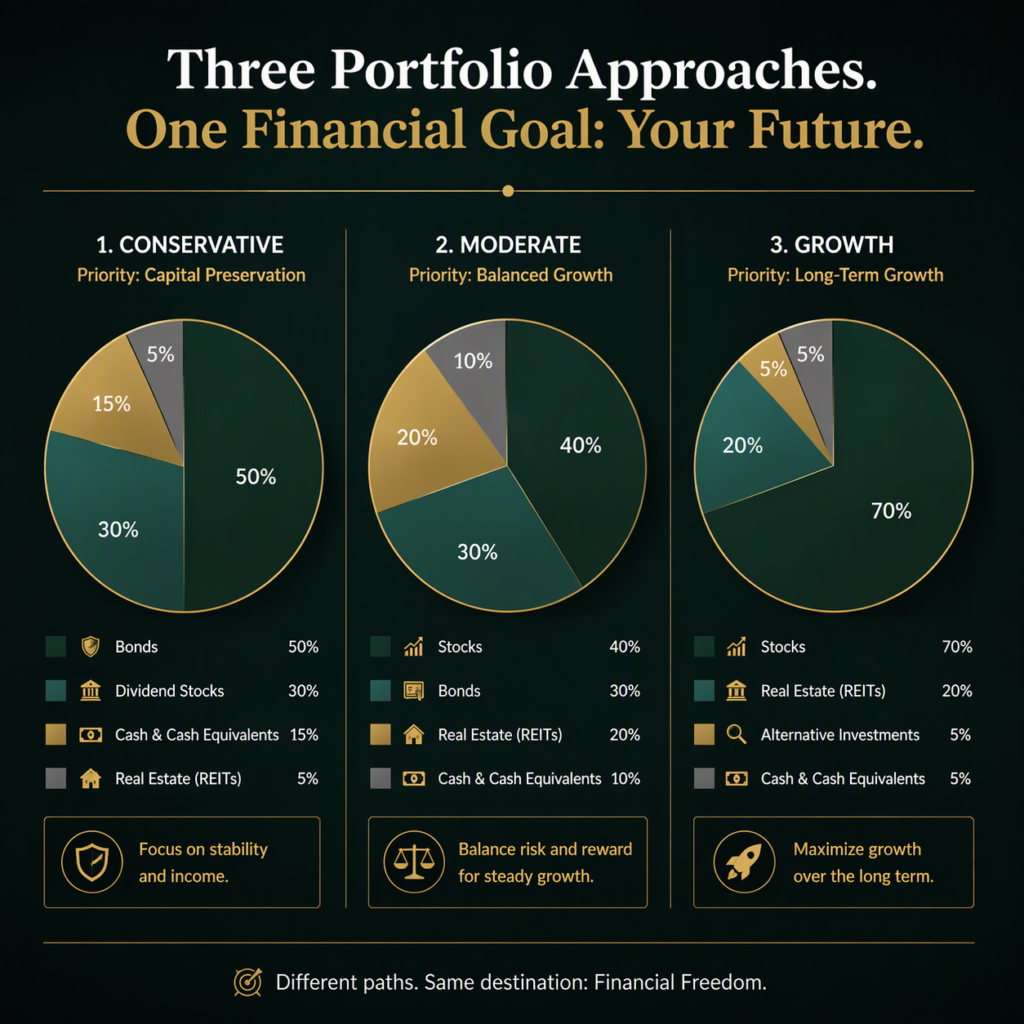
If diversification is the engine of a portfolio, asset allocation is the steering wheel.
Asset allocation refers to how your investments are divided among different asset classes.
For example:
| Asset Class | Allocation |
|---|---|
| Stocks | 70% |
| Bonds | 20% |
| Cash | 10% |
This allocation determines much of your portfolio’s behavior.
In many cases, asset allocation has a greater impact on long-term results than the individual investments selected.
Many investment firms, including Fidelity and Vanguard, emphasize asset allocation as one of the most important decisions investors make because it helps balance risk and return according to individual goals.
Why Asset Allocation Matters
No asset performs best in every market environment.
Stocks may outperform during growth periods.
Bonds may provide stability during uncertainty.
Cash provides flexibility and liquidity.
By combining multiple asset classes, investors can create a portfolio that is better prepared for changing market conditions.
Think of it like building a well-balanced diet.
A healthy diet does not rely on a single food.
Likewise, a healthy investment portfolio should not rely on a single investment.
Example Asset Allocations for Beginners
Conservative
| Asset | Allocation |
|---|---|
| Stocks | 50% |
| Bonds | 40% |
| Cash | 10% |
Best suited for investors who prioritize stability over growth.
Moderate
| Asset | Allocation |
|---|---|
| Stocks | 70% |
| Bonds | 25% |
| Cash | 5% |
Often viewed as a balanced approach.
Growth-Oriented
| Asset | Allocation |
|---|---|
| Stocks | 90% |
| Bonds | 10% |
| Cash | 0% |
Suitable for investors with long time horizons and higher risk tolerance.
Why Diversification Matters
One of the most important investing principles is diversification.
Diversification means spreading investments across multiple areas instead of concentrating everything in one place.
Many beginners make the mistake of believing diversification reduces returns.
In reality, diversification primarily reduces unnecessary risk.
Imagine you invested your entire portfolio in a single company.
If something unexpected happens to that company, your portfolio could suffer significant losses.
Now imagine owning hundreds or thousands of companies through diversified ETFs.
The impact of one company’s problems becomes much smaller.
Types of Diversification
Company Diversification
Owning multiple companies instead of one.
Sector Diversification
Spreading investments across multiple industries such as:
- Technology
- Healthcare
- Financial Services
- Consumer Goods
- Energy
Geographic Diversification
Investing in both domestic and international markets.
Asset Class Diversification
Combining:
- Stocks
- Bonds
- Cash
- REITs
into a single portfolio.
“If you’d like a deeper explanation of diversification principles, read our complete guide on Portfolio Diversification for Beginners.”
9 Proven Strategies for Building Your First Investment Portfolio
Strategy #1: Start With a Clear Goal
The best portfolios begin with a clear purpose.
Ask yourself:
- Why am I investing?
- How long will I invest for?
- What am I trying to achieve?
Examples include:
- Retirement
- Financial independence
- Buying a home
- Building generational wealth
A portfolio without a goal is like a ship without a destination.
Strategy #2: Focus on Long-Term Investing
One reason many beginners struggle is that they focus on short-term results.
Markets move constantly.
Daily headlines can create fear, excitement, and uncertainty.
Successful investors typically measure performance over years and decades rather than days and weeks.
The longer your investment horizon, the less important short-term market movements become.
“Our comprehensive Investment Guide 2026 explains why long-term investing remains one of the most powerful wealth-building approaches available to beginners.”
Strategy #3: Prioritize Broad-Market ETFs
For most new investors, broad-market ETFs provide one of the simplest paths to diversification.
Benefits include:
- Instant diversification
- Low costs
- Simplicity
- Accessibility
Examples include funds tracking:
- The S&P 500
- Total U.S. Stock Market
- Global equities
Many successful portfolios are built primarily around a handful of diversified ETFs.
Strategy #4: Avoid Concentration Risk
A common beginner mistake is investing too much money into a single stock.
Even great companies can experience:
- Economic slowdowns
- Competition
- Regulatory challenges
- Unexpected events
Avoid allowing any single investment to dominate your portfolio.
Diversification exists for a reason.
Strategy #5: Invest Consistently
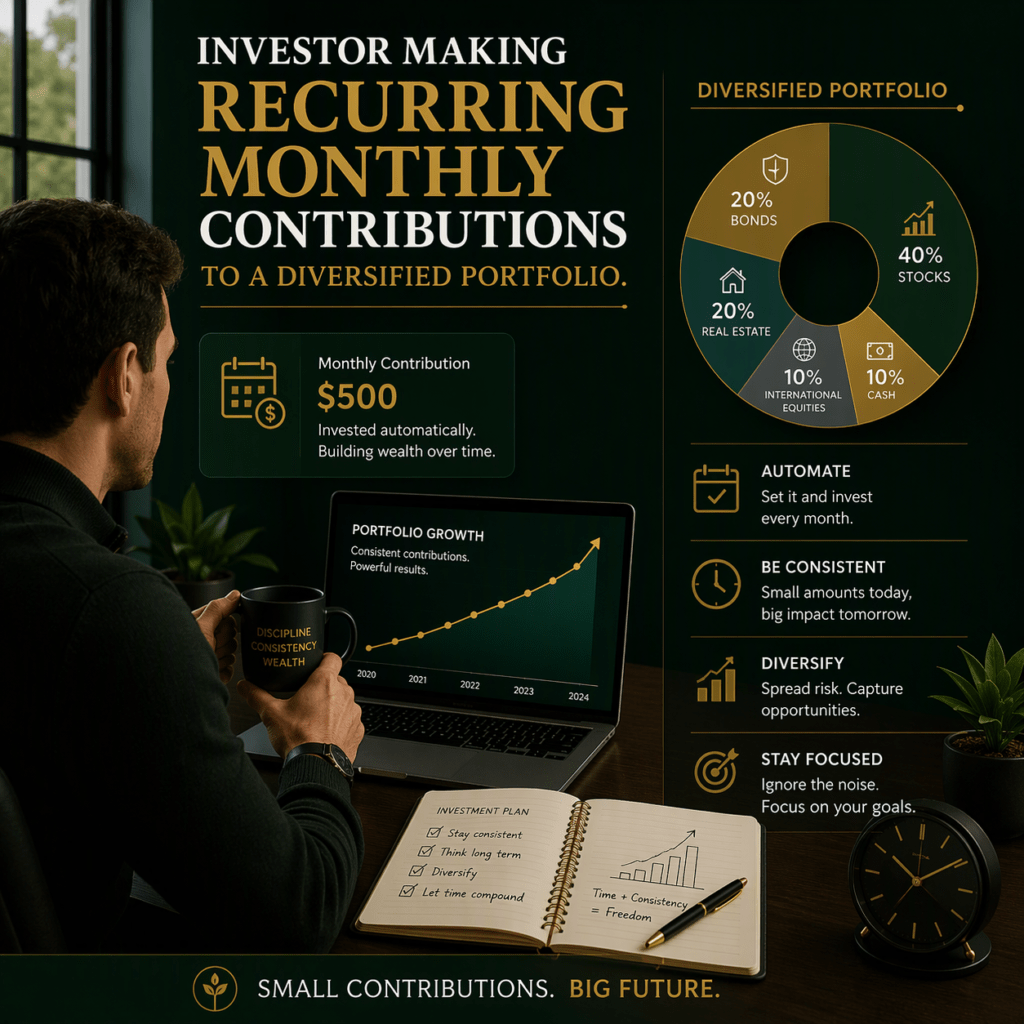
One of the most powerful investing habits is consistency.
Rather than waiting for the perfect moment, many investors choose to invest regularly.
This approach helps:
- Build discipline
- Reduce emotional decisions
- Develop investing habits
- Simplify portfolio growth
Consistency often matters more than perfect timing.
Context Bridge
At this point, you understand the core principles behind successful portfolio construction.
The next step is learning how experienced investors maintain and improve their portfolios over time.
In the next section, we’ll explore the final four portfolio-building strategies, real-world portfolio examples, and the maintenance habits that help long-term investors stay on track.
Build Your Portfolio With More Confidence
If you’re ready to put these concepts into practice, the ETF Portfolio Blueprint can help you understand diversification, allocation, and portfolio design in greater detail.
Strategy #6: Keep Investment Costs Low
Many beginners focus heavily on returns but completely ignore costs.
This can be a costly mistake.
Every dollar paid in fees is a dollar that can no longer compound for your future.
While a 1% annual fee may seem insignificant, its impact can become substantial over decades.
For this reason, many long-term investors favor low-cost index funds and ETFs.
When evaluating any investment, always consider:
- Expense ratios
- Management fees
- Trading commissions
- Account maintenance fees
- Hidden fund costs
One of the easiest ways to improve long-term portfolio performance is simply minimizing unnecessary fees.
Cost awareness is particularly important because even small differences in investment expenses can significantly impact long-term returns. Vanguard and Charles Schwab both provide educational content explaining how fees affect portfolio growth over time.
Strategy #7: Ignore Market Noise
Financial media generates headlines every day.
You’ll constantly see predictions about:
- Recessions
- Market crashes
- Interest rates
- Hot investment opportunities
- Economic uncertainty
Unfortunately, reacting to every headline can damage long-term investment results.
Successful investors understand that uncertainty is a normal part of investing.
Rather than constantly adjusting their portfolio, they focus on:
- Their plan
- Their goals
- Their time horizon
A portfolio should be designed to survive market uncertainty, not avoid it entirely.
The Importance of Investor Discipline
The market rewards discipline more often than prediction.
Many investors fail not because they choose poor investments, but because they abandon good strategies at the wrong time.
Common examples include:
- Selling during market declines
- Buying after large price increases
- Chasing trends
- Constantly changing strategies
This is where mindset becomes extremely important.
“The emotional side of investing is often harder than the technical side. Our guide on How to Build a Strong Investment Mindset Before You Start Investing explains how successful investors stay disciplined during market uncertainty.”
Strategy #8: Rebalance Your Portfolio Periodically
Over time, portfolio allocations naturally change.
Imagine a portfolio that initially looks like this:
| Asset | Initial Allocation |
|---|---|
| Stocks | 70% |
| Bonds | 30% |
Suppose stocks perform exceptionally well for several years.
The portfolio may eventually become:
| Asset | New Allocation |
|---|---|
| Stocks | 82% |
| Bonds | 18% |
Without realizing it, the portfolio has become significantly riskier.
This is where rebalancing becomes important.
What Is Rebalancing?
Rebalancing is the process of returning your portfolio to its target allocation.
This can involve:
- Selling assets that have grown too large
- Buying underweighted assets
- Adjusting future contributions
The goal is not to maximize returns.
The goal is to maintain your intended risk level.
How Often Should You Rebalance?
There is no perfect answer.
Many investors choose:
- Once per year
- Twice per year
- When allocations drift significantly
The key is consistency rather than frequency.
Avoid making frequent changes based on short-term market movements.
Strategy #9: Stay Invested Through Market Cycles

One of the greatest advantages individual investors possess is time.
Markets go through cycles.
Throughout history, investors have experienced:
- Bull markets
- Bear markets
- Recessions
- Corrections
- Economic expansions
Yet over long periods, diversified portfolios have generally rewarded patient investors.
The challenge is remaining invested when emotions become intense.
Many of the wealthiest investors in history have emphasized the same lesson:
Stay focused on the long term.
Market volatility is temporary.
Long-term wealth building is the goal.
Stocks vs ETFs in Your First Portfolio
One of the most common questions beginners ask is:
“Should I invest in stocks or ETFs?”
The answer depends on your goals, knowledge, and comfort level.
For many beginners, ETFs offer a simpler starting point.
Research and educational resources from BlackRock’s iShares platform show that ETFs are widely used by investors seeking broad market exposure and diversification through a single investment.
Let’s compare the two.
| Feature | ETFs | Individual Stocks |
|---|---|---|
| Diversification | High | Low |
| Risk | Lower | Higher |
| Complexity | Lower | Higher |
| Research Required | Less | More |
| Beginner Friendly | Yes | Moderate |
Why Many Beginners Start With ETFs
ETFs provide instant diversification.
Instead of researching dozens of companies, you can gain exposure to entire markets through a single fund.
Benefits include:
- Lower risk concentration
- Simplicity
- Broad market exposure
- Lower maintenance
This is one reason ETFs have become one of the most popular investment vehicles in the world.
“If you’re considering ETFs as the foundation of your portfolio, our guide on How to Invest in ETFs for Beginners explains the process step by step.”
When Individual Stocks May Make Sense
Individual stocks can still play a role.
Some investors allocate a small portion of their portfolio to:
- Companies they strongly understand
- Specific industries
- Long-term growth opportunities
However, beginners should generally avoid building an entire portfolio around a small number of stocks.
Diversification remains a critical principle.
“For investors interested in selecting individual companies, our guide on How to Invest in Stocks for Beginners explains how to evaluate stocks responsibly.”
Sample Beginner Investment Portfolios
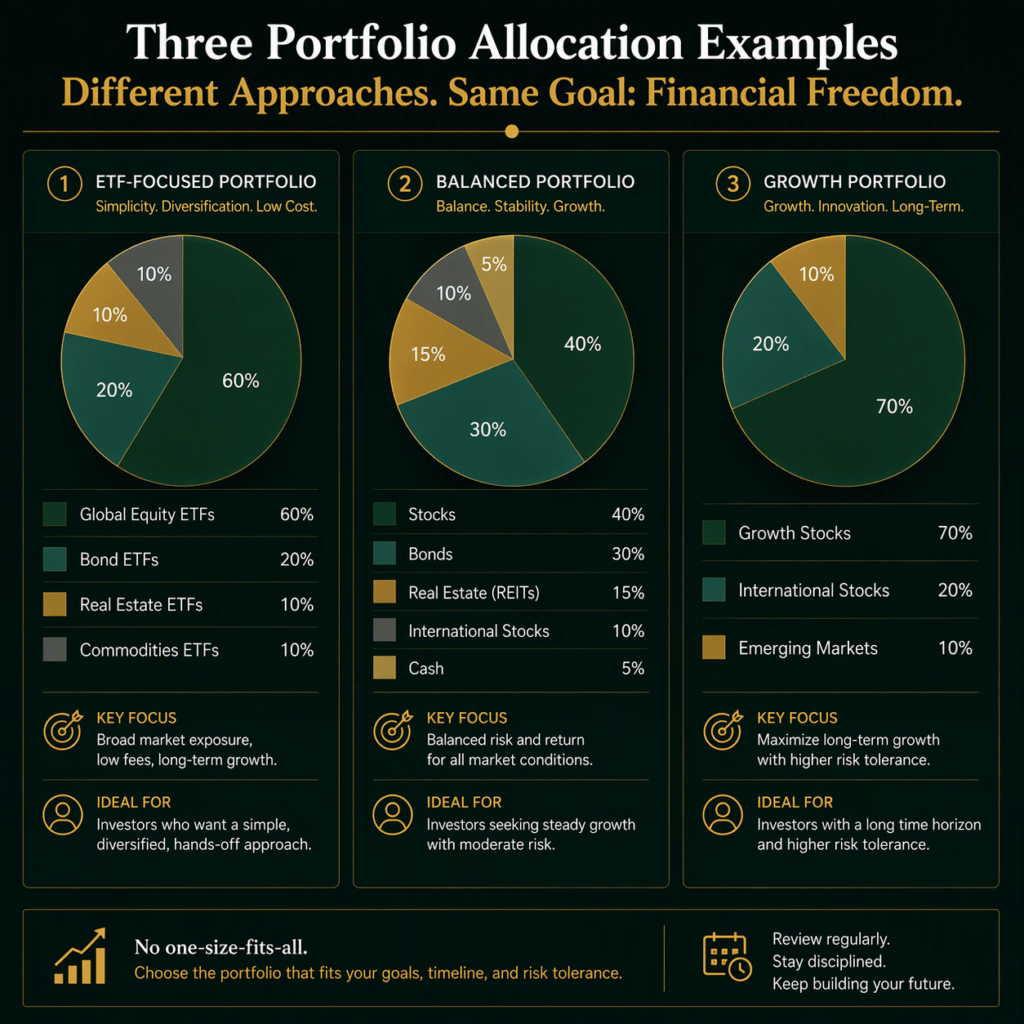
The following examples are illustrations only.
They are not investment recommendations.
Their purpose is to demonstrate how different investors might approach portfolio construction.
Example #1: ETF-Focused Beginner Portfolio
Designed for simplicity.
| Asset | Allocation |
|---|---|
| U.S. Stock Market ETF | 60% |
| International ETF | 25% |
| Bond ETF | 15% |
Potential benefits:
- Broad diversification
- Low maintenance
- Beginner friendly
Example #2: Balanced Portfolio
Designed for moderate growth and stability.
| Asset | Allocation |
|---|---|
| U.S. Stocks | 50% |
| International Stocks | 20% |
| Bonds | 25% |
| Cash | 5% |
Potential benefits:
- Risk management
- Diversification
- Long-term growth potential
Example #3: Growth-Oriented Portfolio
Designed for investors with long time horizons.
| Asset | Allocation |
|---|---|
| U.S. Stocks | 65% |
| International Stocks | 25% |
| Bonds | 10% |
Potential benefits:
- Higher growth potential
- Long-term focus
Potential drawback:
- Higher volatility
Portfolio Maintenance: What Successful Investors Do
Building a portfolio is only the beginning.
Maintaining it is where long-term success often comes from.
Successful investors typically focus on a few repeatable habits.
Continue Investing Regularly
Consistent contributions are one of the most powerful wealth-building tools available.
Many investors automate contributions to remove emotion and simplify investing.
Review Goals Periodically
Your goals may change over time.
Common life events include:
- Marriage
- Children
- Career changes
- Home purchases
- Retirement planning
A portfolio should evolve as your circumstances change.
Avoid Unnecessary Trading
Constant trading can create:
- Higher costs
- Emotional decisions
- Tax complications
- Reduced long-term focus
A portfolio should not require daily attention.
Focus on Process Over Results
Investors cannot control market returns.
However, they can control:
- Savings rate
- Diversification
- Costs
- Discipline
- Asset allocation
The process often matters more than short-term outcomes.
Context Bridge
By now, you understand how to structure a portfolio, allocate assets, diversify effectively, and maintain a long-term strategy.
However, even strong portfolios can be undermined by common mistakes that many new investors make.
Understanding these mistakes can save years of frustration and help you stay on the path toward long-term wealth building.
Build Your Portfolio Using Proven Diversification Principles
If you’d like a practical framework for creating and managing a diversified portfolio, download the ETF Portfolio Blueprint.
Common Portfolio Mistakes Beginners Should Avoid
Even a well-designed portfolio can underperform if you make avoidable mistakes.
The good news is that many investing mistakes are preventable once you understand what to watch for.
Mistake #1: Investing Without a Plan
Many beginners start investing without defining:
- Their goals
- Their timeline
- Their risk tolerance
- Their strategy
This often leads to confusion and inconsistent decisions.
Before investing, understand what you’re trying to achieve and how your portfolio supports that objective.
Mistake #2: Chasing Hot Investments
Every year, certain investments become extremely popular.
Investors often rush into:
- Trending stocks
- Speculative sectors
- Market fads
- Social media recommendations
Unfortunately, by the time many investors hear about these opportunities, much of the growth may have already occurred.
Successful investing typically rewards discipline more than excitement.
Mistake #3: Trying to Time the Market
Many investors wait for the “perfect” moment to invest.
The problem is that nobody consistently knows when markets will:
- Peak
- Bottom
- Recover
- Correct
Waiting for perfect conditions can result in years spent on the sidelines.
Investor.gov warns that attempts to consistently time market movements are extremely difficult, even for experienced professionals.
A consistent investing strategy is often more effective than attempting to predict short-term market movements.
Mistake #4: Ignoring Diversification
Concentrating too much money into one company, sector, or asset class can increase risk significantly.
Diversification helps reduce the impact of any single investment performing poorly.
“Understanding proper diversification is one of the most important lessons covered in our guide to Portfolio Diversification for Beginners.”
Mistake #5: Letting Emotions Drive Decisions
Fear and greed are among the biggest enemies of investors.
Fear may cause investors to sell during downturns.
Greed may encourage investors to take excessive risks.
Developing emotional discipline is often just as important as choosing investments.
Mistake #6: Lack of Consistency
Some investors contribute regularly for a few months and then stop.
Long-term wealth building usually depends on consistency.
Regular investing allows compounding to work over time.
FAQ
How much money do I need to build my first investment portfolio?
Many modern investing platforms allow beginners to start with relatively small amounts of money.
The amount matters less than developing the habit of investing consistently.
Whether you begin with $100 or $1,000, building good investing habits is often the most important first step.
Is an ETF portfolio good for beginners?
For many beginners, yes.
ETFs typically provide instant diversification, lower maintenance requirements, and broad market exposure.
This simplicity makes them one of the most popular starting points for new investors.
How many investments should be in a beginner portfolio?
There is no perfect number.
A single diversified ETF may provide exposure to hundreds or thousands of companies.
The focus should be on diversification rather than the number of holdings.
How often should I check my portfolio?
Many successful long-term investors avoid checking their portfolios daily.
Reviewing periodically, such as monthly or quarterly, is often sufficient.
Constant monitoring can encourage emotional decision-making.
Can I build a portfolio using only ETFs?
Yes.
Many investors build highly diversified portfolios using ETFs alone.
A combination of stock market ETFs, international ETFs, and bond ETFs can provide substantial diversification.
What should I do if the stock market crashes?
Market declines are a normal part of investing.
Historically, markets have experienced corrections, bear markets, and recessions while continuing to reward long-term investors over extended periods.
A well-built portfolio should be designed with these periods in mind.
Should beginners invest in stocks or ETFs?
For many beginners, ETFs offer a simpler and more diversified starting point.
Individual stocks may be appropriate later as investors gain experience and confidence.
What is the most important part of a successful portfolio?
While many factors matter, consistency is often the most important.
A good portfolio combined with regular investing, patience, and discipline can be extremely powerful over decades.
Final Thoughts
Learning how to build your first investment portfolio is one of the most important milestones in your journey toward financial independence and long-term wealth building.
The good news is that building a portfolio doesn’t require predicting the market, finding the next winning stock, or becoming a financial expert overnight.
Instead, successful investing often comes down to mastering a handful of timeless principles:
- Diversification
- Asset allocation
- Consistency
- Patience
- Discipline
- Long-term thinking
Remember that your portfolio does not need to be perfect.
It simply needs to align with your goals and allow you to stay invested through the inevitable ups and downs of the market.
The investors who build wealth over time are rarely the ones who make the most dramatic moves.
They are usually the ones who follow a sound plan and stick with it.
Your Next Step: Start Building Your Portfolio Today
Now that you understand how to build your first investment portfolio, the next step is to put these principles into action.
Start by:
- Defining your investment goals
- Understanding your risk tolerance
- Choosing an appropriate asset allocation
- Building a diversified portfolio
- Investing consistently
Remember that investing is a journey, not a race.
Every successful investor started with a first investment and a first portfolio.
The sooner you begin learning and taking action, the more time you give your money to grow.
Build a Diversified Portfolio With Confidence
Join Invest Smart Weekly
Join Invest Smart Weekly and receive practical investing insights, market updates, portfolio-building strategies, and beginner-friendly financial education delivered directly to your inbox.
Stay informed, improve your investing knowledge, and build confidence one step at a time.
About the Author
Mario Cazombo is the founder of InvestSmartEdge, a platform dedicated to helping beginner investors build wealth through practical financial education, long-term investing strategies, portfolio-building principles, and smart investing tools.
His mission is to simplify investing and help new investors make better financial decisions with confidence.
Related Articles
Recommended Reading
- How to Start Investing in 2026
- Investment Guide 2026
- How to Invest in ETFs for Beginners
- How to Invest in Stocks for Beginners
- Portfolio Diversification for Beginners