
Investment Basics for Beginners in 2026
Discover the 9 essential investment basics every beginner must know before making their first investment. Learn investing fundamentals, risk management, diversification, and wealth-building principles.
Table of Contents
- Why Investment Basics Matter
- What Is Investing?
- Investment Basic #1: Understanding Stocks
- Investment Basic #2: Understanding ETFs
- Investment Basic #3: Understanding Ownership
- Why Investment Basics Build Confidence
- Frequently Asked Questions
- Final Thoughts
Introduction
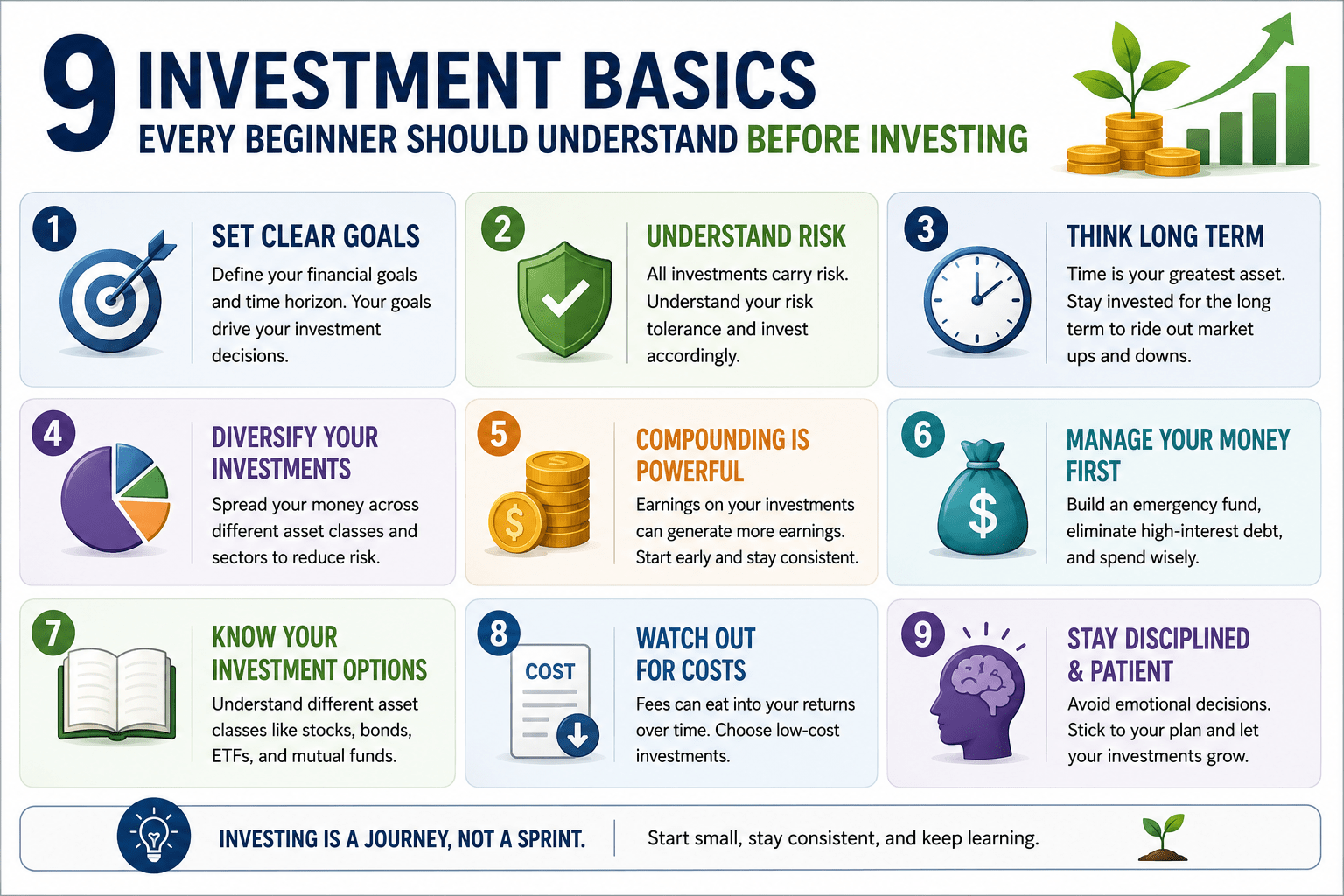
Before buying your first stock, ETF, or investment fund, it’s important to understand the investment basics that form the foundation of successful investing.
Many beginner investors rush into the market without learning these investment basics and later discover they made decisions they didn’t fully understand.
The good news is that investing does not require a finance degree.
However, understanding a few essential investment basics can dramatically improve your confidence and decision-making.
This guide explains the investment basics every beginner investor should master before making their first investment.
Think of these concepts as the building blocks of your investing education.
Without strong foundations, long-term investing becomes much more difficult.
With strong foundations, investing becomes significantly more manageable.
Why Investment Basics Matter
One of the biggest reasons beginner investors struggle is a lack of foundational knowledge.
Many people focus immediately on:
- Which stock to buy
- Which ETF to choose
- Which platform to use
Yet they never take time to understand the investment basics behind those decisions.
Understanding investment basics helps investors:
✔ Make informed decisions
✔ Reduce emotional investing
✔ Understand risk
✔ Build confidence
✔ Avoid common mistakes
The Difference Between Investing and Gambling
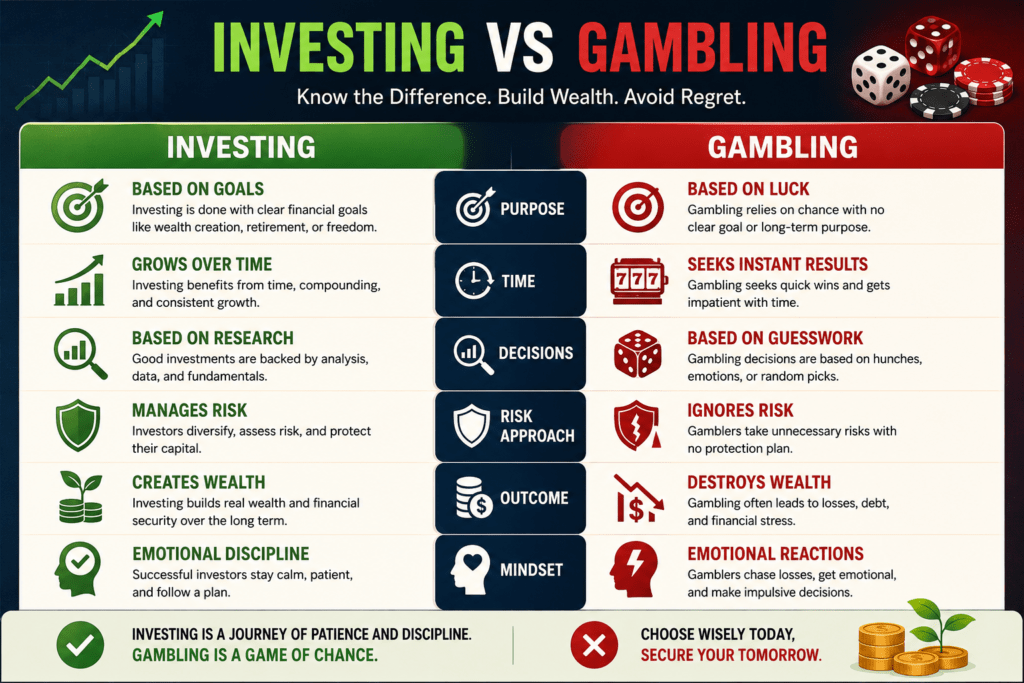
One of the most important investment basics is understanding the difference between investing and speculation.
Investing involves:
- Research
- Strategy
- Long-term thinking
- Risk management
Gambling often involves:
- Guessing
- Emotion
- Short-term outcomes
- Lack of planning
The SEC Investor Education Center emphasizes that successful investing is typically based on planning and diversification rather than speculation.
What Is Investing?
At its core, investing means putting money into assets with the expectation that those assets may increase in value over time.
Understanding this simple definition is one of the most important investment basics.
Investments may include:
- Stocks
- ETFs
- Bonds
- Mutual Funds
- Real Estate Investments
The goal is typically to grow wealth over time.
Why People Invest
People invest for many different reasons.
Common goals include:
Retirement
Building financial security for the future.
Financial Independence
Creating freedom and flexibility.
Wealth Building
Growing assets over time.
Education Funding
Saving for future educational expenses.
Passive Income
Generating future income streams.
If you’re completely new to investing, start with:
How to Start Investing in 2026
Investment Basic #1: Understanding Stocks
One of the first investment basics every beginner should learn is how stocks work.
A stock represents ownership in a company.
When you purchase shares of a company, you become a partial owner.
What Happens When a Company Grows?
If a company performs well:
- Revenue may increase
- Profits may increase
- Share prices may rise
As a shareholder, you may benefit from that growth.
What Happens When a Company Struggles?
If a company performs poorly:
- Share prices may decline
- Investor confidence may weaken
- Losses may occur
This is why understanding risk is one of the most important investment basics.
Why Stocks Can Build Wealth
Historically, stocks have been one of the most effective tools for long-term wealth building.
However, they can also experience periods of volatility.
Understanding this balance between risk and reward is essential.

Investment Basic #2: Understanding ETFs
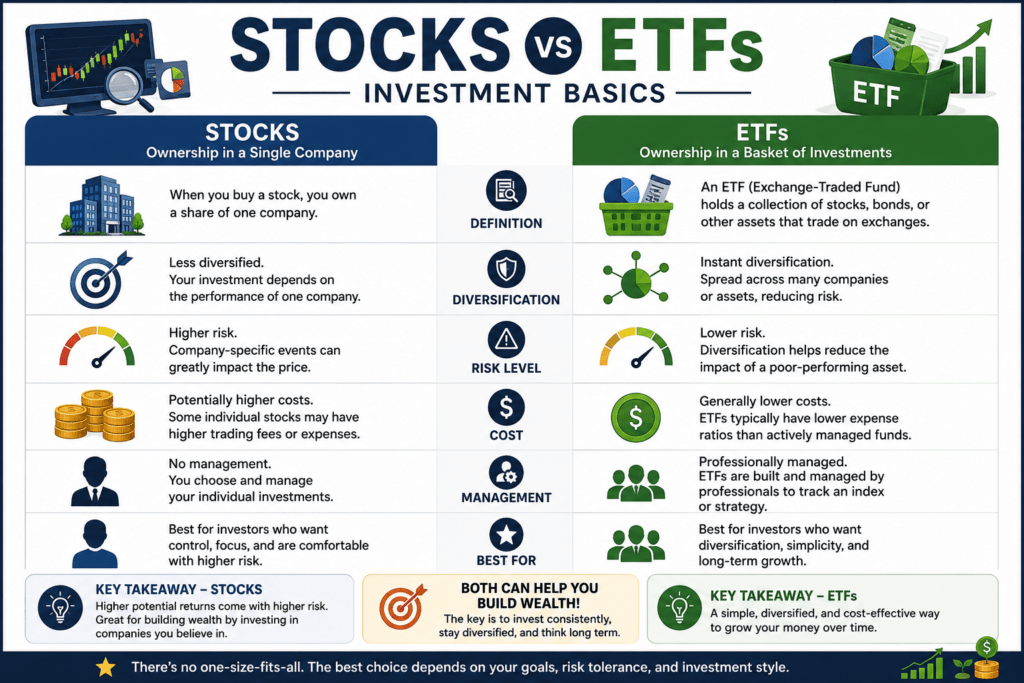
Another critical investment basic involves Exchange-Traded Funds, commonly known as ETFs.
Many beginner investors start with ETFs because they offer built-in diversification.
What Is an ETF?
An ETF is a collection of investments bundled together into a single fund.
Instead of buying one company, an investor can gain exposure to many companies through a single ETF.
Examples include:
- S&P 500 ETFs
- Total Market ETFs
- International ETFs
Why ETFs Are Popular
ETFs offer several advantages:
✔ Diversification
✔ Simplicity
✔ Lower costs
✔ Accessibility
✔ Reduced company-specific risk
Learn more:
Stocks vs ETFs for Beginners
FREE ETF BEGINNER BLUEPRINT
No spam.
Investment Basic #3: Understanding Ownership
One of the most overlooked investment basics is ownership.
Investing is not simply buying symbols on a screen.
When you invest, you are often purchasing ownership in businesses and productive assets.
Why Ownership Matters
Ownership allows investors to participate in:
- Business growth
- Economic growth
- Innovation
- Wealth creation
This mindset helps investors think differently.
Instead of viewing investments as lottery tickets, they begin viewing them as ownership stakes in productive assets.
How Successful Investors Think
Many successful investors focus less on:
“What will happen tomorrow?”
and more on:
“What can this investment become over the next decade?”
This shift in thinking encourages patience and long-term decision-making.
The educational resources available through Fidelity Learning Center frequently emphasize the importance of understanding ownership and long-term investing principles.
Why Investment Basics Build Confidence
Many investing fears originate from uncertainty.
The more investors understand the investment basics, the more confidence they typically develop.
Knowledge does not eliminate risk.
However, it often reduces confusion.
Confidence comes from understanding.
Not from predicting the future.
The Beginner Investor Advantage
The good news is that modern investors have access to more educational resources than ever before.
With consistent learning and a structured roadmap, beginners can develop strong investing foundations relatively quickly.

Investment Basic #4: Understanding Bonds
When discussing investment basics, most beginners immediately think about stocks.
However, bonds are another important asset class that every investor should understand.
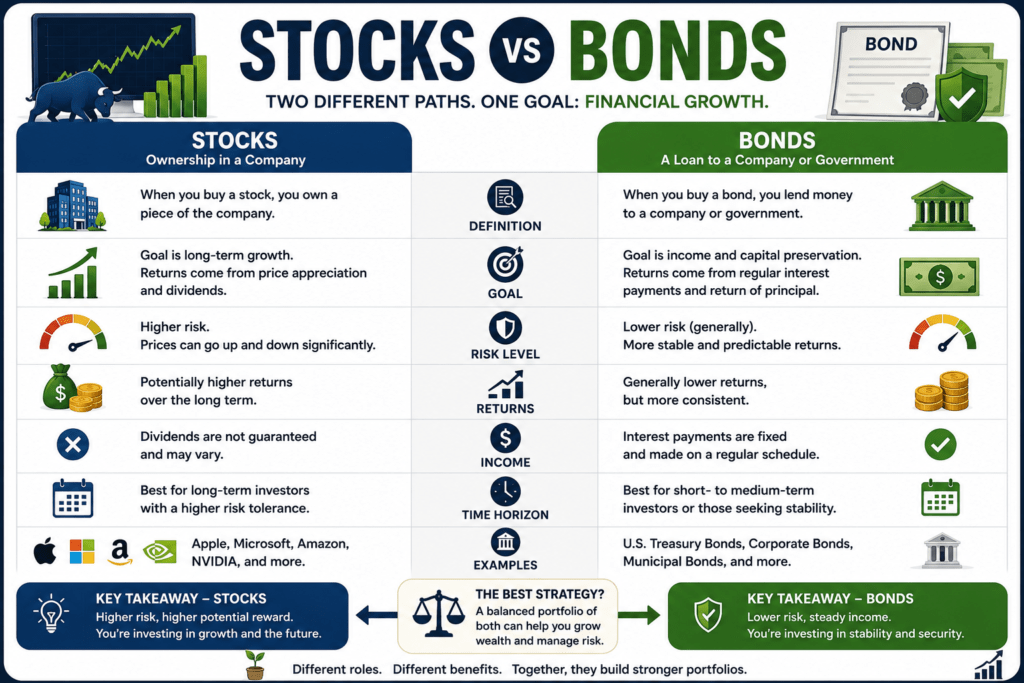
A bond is essentially a loan.
When investors buy bonds, they are lending money to:
- Governments
- Municipalities
- Corporations
In return, the issuer agrees to pay interest and eventually return the principal amount.
Why Bonds Matter
Bonds often play a different role than stocks.
While stocks are generally associated with growth, bonds are often associated with:
- Stability
- Income
- Risk reduction
This is why many diversified portfolios include both stocks and bonds.
Are Bonds Risk-Free?
No investment is completely risk-free.
However, many high-quality bonds are generally considered less volatile than stocks.
Understanding this balance is one of the most important investment basics for portfolio construction.
Investment Basic #5: Understanding Risk and Reward
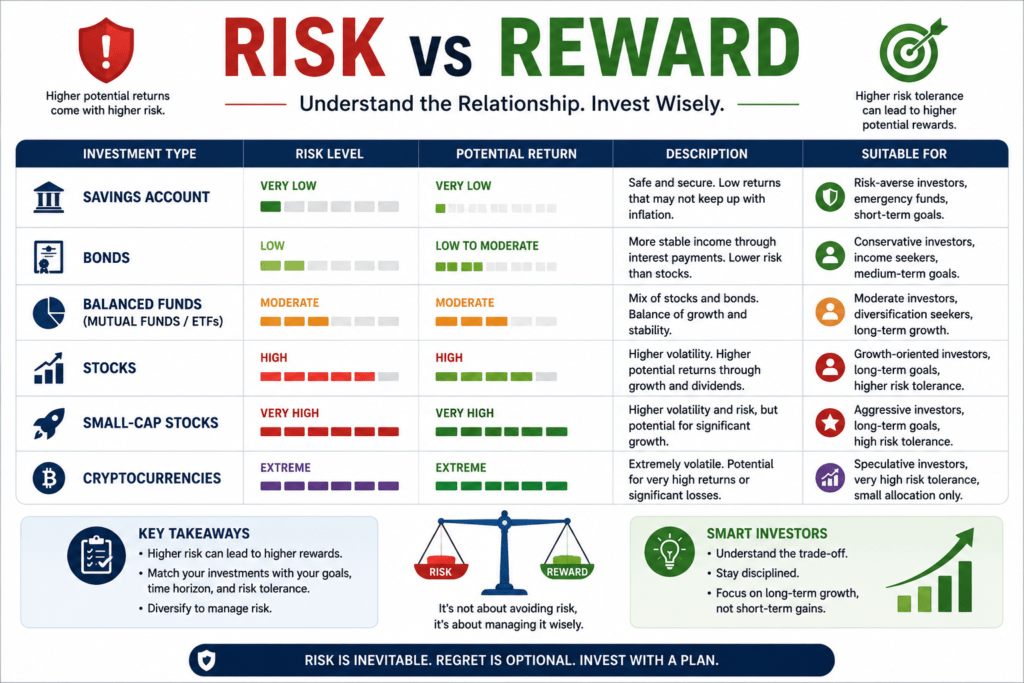
One of the most essential investment basics is understanding the relationship between risk and reward.
Many beginner investors focus only on potential returns.
Successful investors also evaluate potential risks.
The Risk-Reward Relationship
In general:
Higher potential returns often involve higher risk.
Lower risk investments often offer lower expected returns.
Examples:
High Risk
- Individual growth stocks
- Emerging markets
- Speculative investments
Moderate Risk
- Broad market ETFs
- Diversified stock portfolios
Lower Risk
- High-quality bonds
- Cash equivalents
Why Risk Matters
Understanding risk helps investors:
✔ Build realistic expectations
✔ Avoid emotional decisions
✔ Create diversified portfolios
✔ Stay invested during market volatility
The FINRA Investor Education Center provides valuable educational resources regarding investment risk and investor protection.
Investment Basic #6: Understanding Diversification
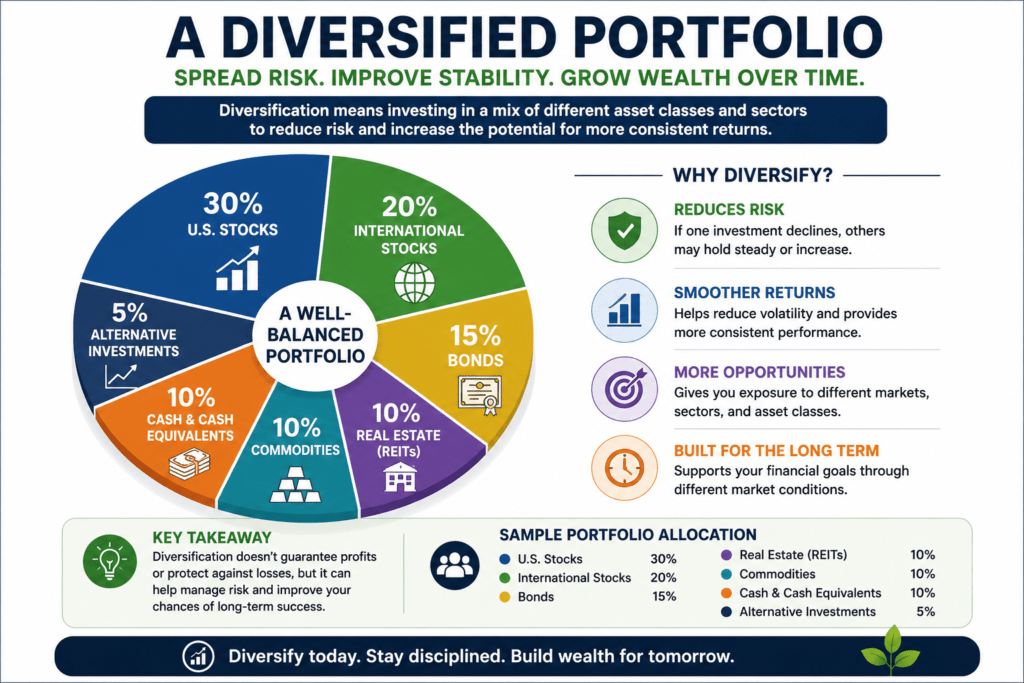
If there is one investment basic that appears repeatedly throughout successful investing, it is diversification.
Diversification means spreading investments across multiple assets.
The objective is simple:
Reduce the impact of any single investment performing poorly.
Why Diversification Works
Imagine investing your entire portfolio in one company.
If that company struggles, your portfolio may suffer significantly.
Now imagine owning:
- Hundreds of companies
- Multiple sectors
- Different countries
- Various asset classes
Risk becomes more balanced.
Diversification Through ETFs
This is one reason ETFs are so popular among beginner investors.
A single ETF can provide exposure to hundreds or even thousands of investments.
Learn more:
Portfolio Diversification for Beginners
Investment Basic #7: Understanding Compound Growth
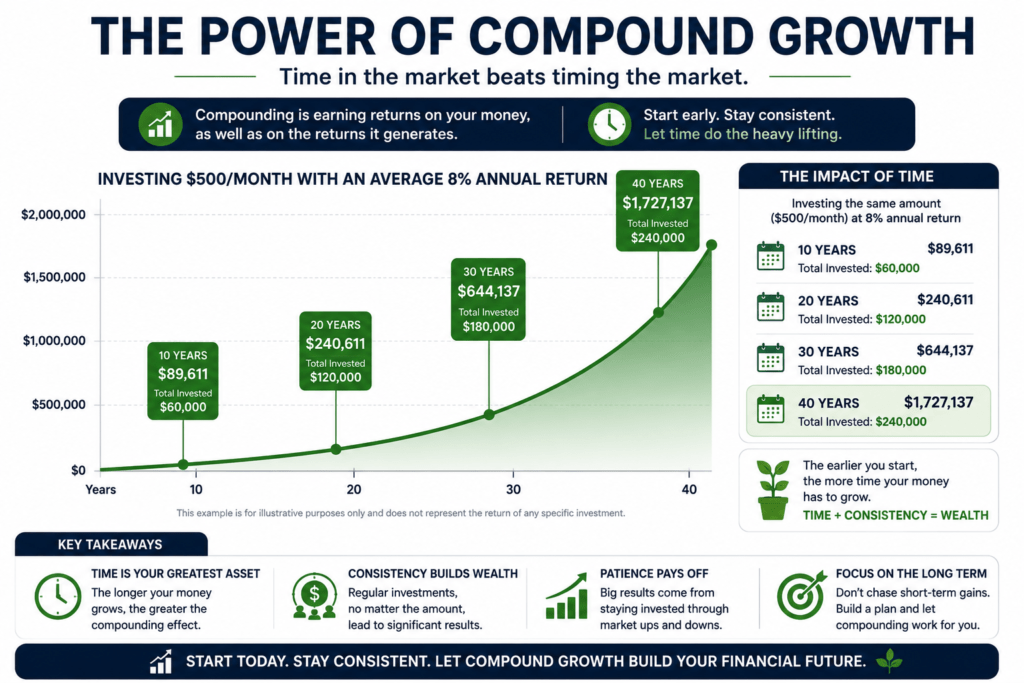
Compound growth is one of the most powerful investment basics every investor should understand.
Many people underestimate how dramatically compounding can influence long-term wealth.
What Is Compound Growth?
Compound growth occurs when:
Investment Returns
↓
Generate Additional Returns
↓
Which Generate More Returns
↓
Repeated Over Time
This creates a snowball effect.
Why Time Is So Important
Many investors focus on investing larger amounts.
However, starting earlier is often more powerful than starting larger.
The longer compounding works, the greater its potential impact.
Example
Investor A:
Starts investing at age 25.
Investor B:
Starts investing at age 40.
Even if Investor B contributes more money initially, Investor A may still achieve superior long-term results because of time.
Educational Resource
Investopedia provides excellent educational material regarding compound growth and long-term investing principles.
Investment Basic #8: Understanding Inflation
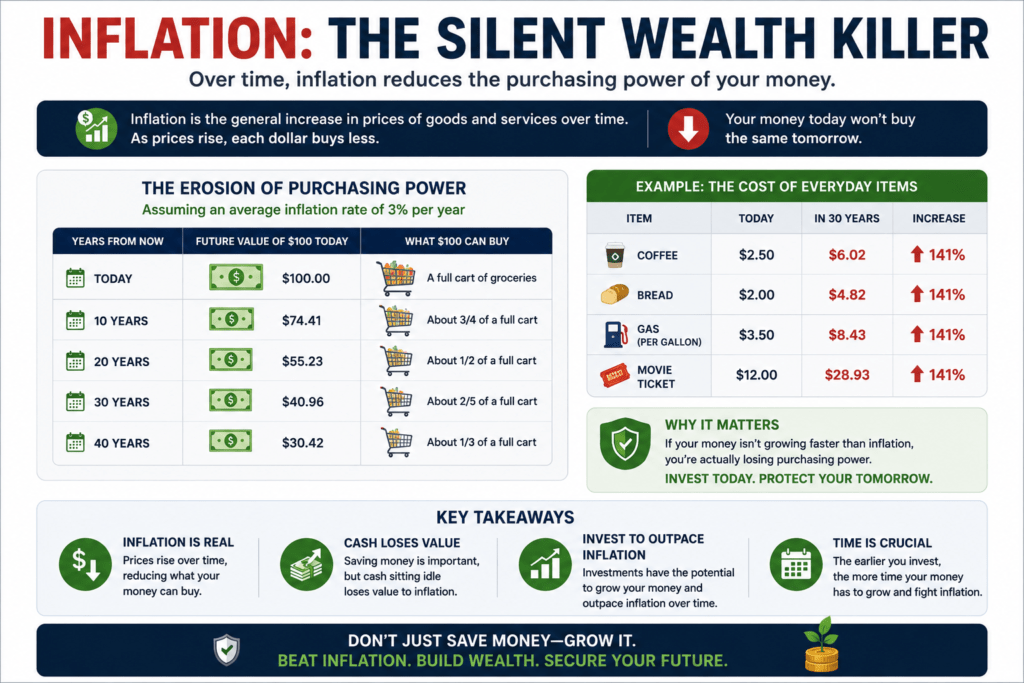
Inflation is one of the most overlooked investment basics.
Many people save money but fail to consider how inflation affects purchasing power.
What Is Inflation?
Inflation refers to the gradual increase in prices over time.
As prices rise:
The purchasing power of money declines.
In simple terms:
The same amount of money buys less in the future.
Why Inflation Matters to Investors
Inflation is one reason many people invest.
Investments can potentially help preserve and grow purchasing power over time.
Without investing, inflation may gradually erode the value of savings.
Example
Imagine:
$1,000 today
may not have the same purchasing power
10 years from now.
Understanding inflation helps investors appreciate the importance of long-term wealth building.
Investment Basic #9: Understanding Time Horizons
One of the most important investment basics involves understanding your investment time horizon.
A time horizon refers to how long you expect to keep your money invested before needing it.
Short-Term Time Horizons
Examples:
- Less than 3 years
- Emergency savings goals
- Near-term purchases
These goals often require lower-risk approaches.
Medium-Term Time Horizons
Examples:
- 3 to 10 years
- Home purchase goals
- Education funding
Moderate risk may be appropriate.
Long-Term Time Horizons
Examples:
- Retirement
- Financial independence
- Wealth building
Longer time horizons often allow investors to tolerate greater market volatility.
Why Time Horizons Matter
Your time horizon influences:
- Risk tolerance
- Asset allocation
- Portfolio construction
- Investment strategy
This is one reason successful investors begin with goals rather than investments.
Bringing These Investment Basics Together
By now, you’ve learned:
✔ Stocks
✔ ETFs
✔ Ownership
✔ Bonds
✔ Risk and Reward
✔ Diversification
✔ Compound Growth
✔ Inflation
✔ Time Horizons
Together, these investment basics form the foundation of successful investing.
Without understanding these concepts, investing can feel confusing.
With them, investing becomes significantly more manageable.
Understanding Bull and Bear Markets
One of the most important investment basics that every beginner investor should understand is the difference between bull markets and bear markets.
Markets do not move in a straight line.
They experience cycles of growth, optimism, fear, corrections, and recovery.
Understanding these cycles helps investors make better decisions and avoid emotional reactions.
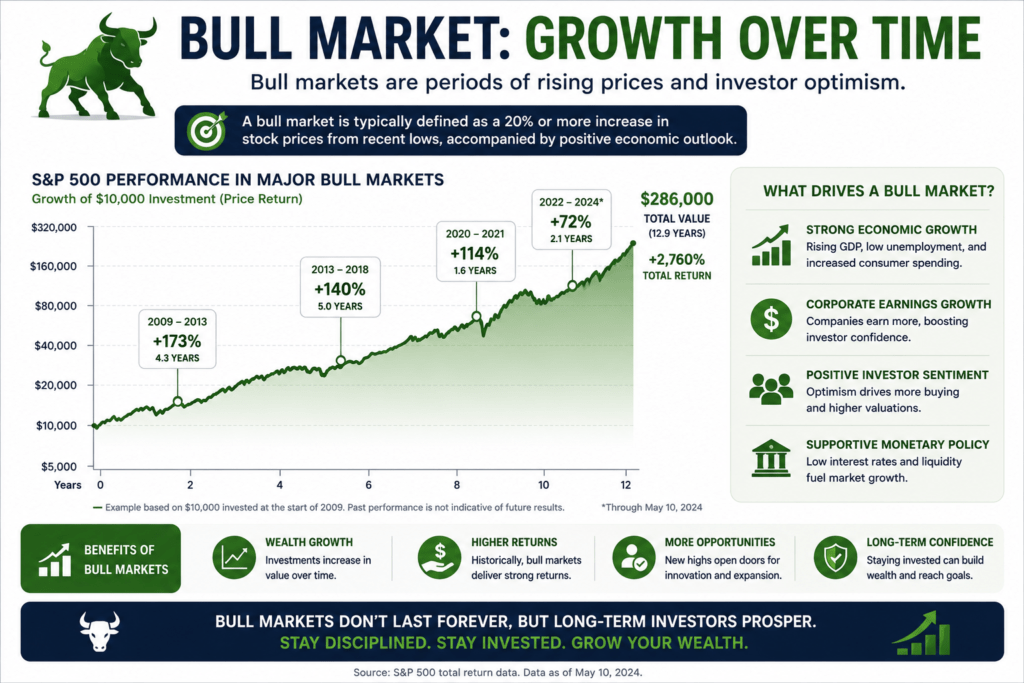
What Is a Bull Market?
A bull market occurs when asset prices generally rise over an extended period.
Bull markets are often characterized by:
- Economic growth
- Rising investor confidence
- Increasing company earnings
- Positive market sentiment
During bull markets, many investors feel optimistic about the future.
Characteristics of Bull Markets
Common signs include:
✔ Rising stock prices
✔ Strong economic activity
✔ Growing corporate profits
✔ Increased investor participation
Why Bull Markets Matter
Bull markets create opportunities for long-term investors to grow wealth.
However, one of the most important investment basics is understanding that bull markets do not last forever.
Eventually, markets experience periods of decline.
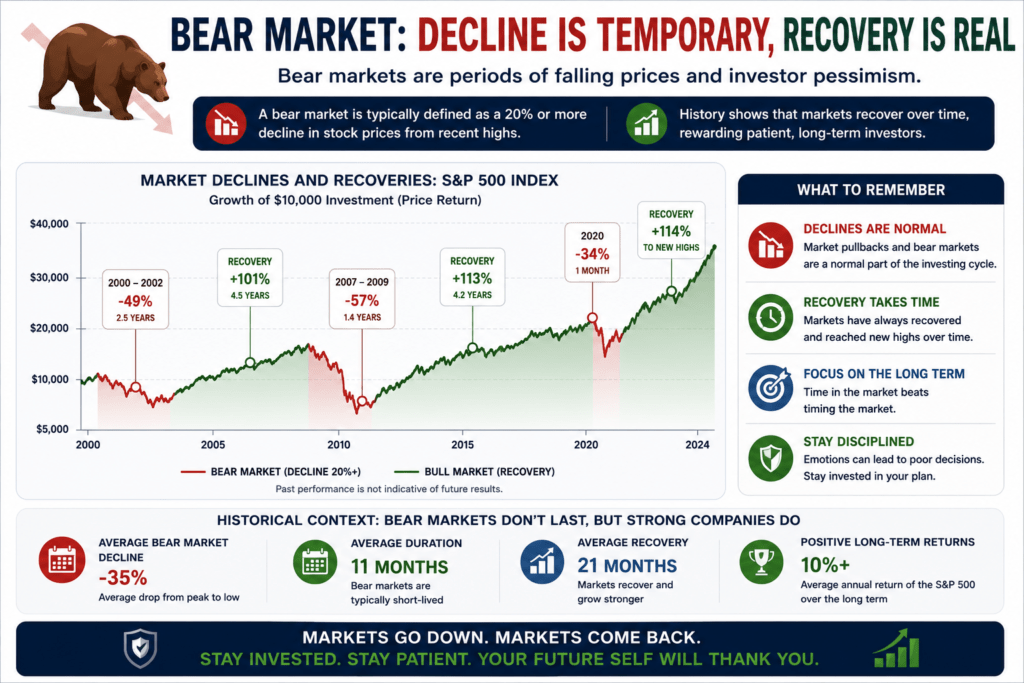
What Is a Bear Market?
A bear market occurs when markets experience a significant decline over a prolonged period.
Bear markets are often associated with:
- Economic uncertainty
- Negative sentiment
- Reduced investor confidence
- Market volatility
For beginner investors, bear markets can feel intimidating.
However, they are a normal part of investing.
Characteristics of Bear Markets
Common signs include:
✔ Falling stock prices
✔ Increased volatility
✔ Negative market sentiment
✔ Economic concerns
Why Bear Markets Matter
One of the most valuable investment basics is understanding that bear markets create both risks and opportunities.
Many successful investors continue investing during market downturns.
This allows them to purchase investments at lower prices.
Historically, markets have recovered from numerous bear markets over time.
Understanding Market Volatility
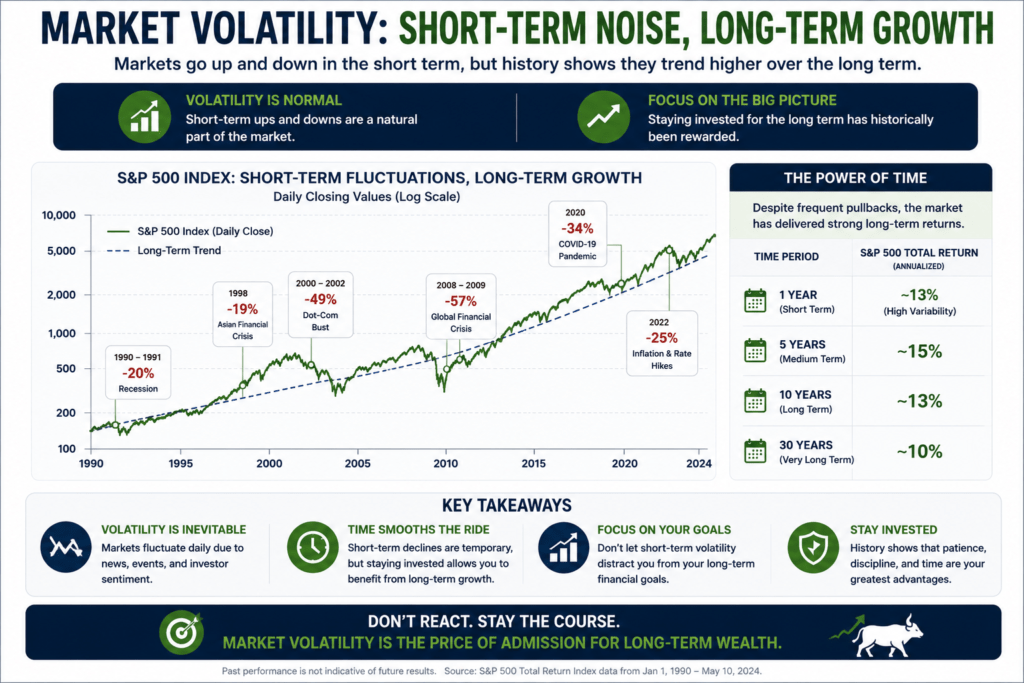
Another essential investment basic is understanding volatility.
Volatility refers to how much investment prices fluctuate over time.
Many beginner investors fear volatility.
Experienced investors often view volatility as a normal part of investing.
Why Volatility Exists
Markets react to:
- Economic news
- Interest rates
- Corporate earnings
- Global events
- Investor sentiment
These factors create short-term fluctuations.
Volatility Is Not the Same as Risk
One of the most misunderstood investment basics is the difference between volatility and risk.
Volatility:
Short-term price movements.
Risk:
The possibility of permanently losing capital.
Understanding this distinction helps investors remain calm during market fluctuations.
Understanding Asset Allocation
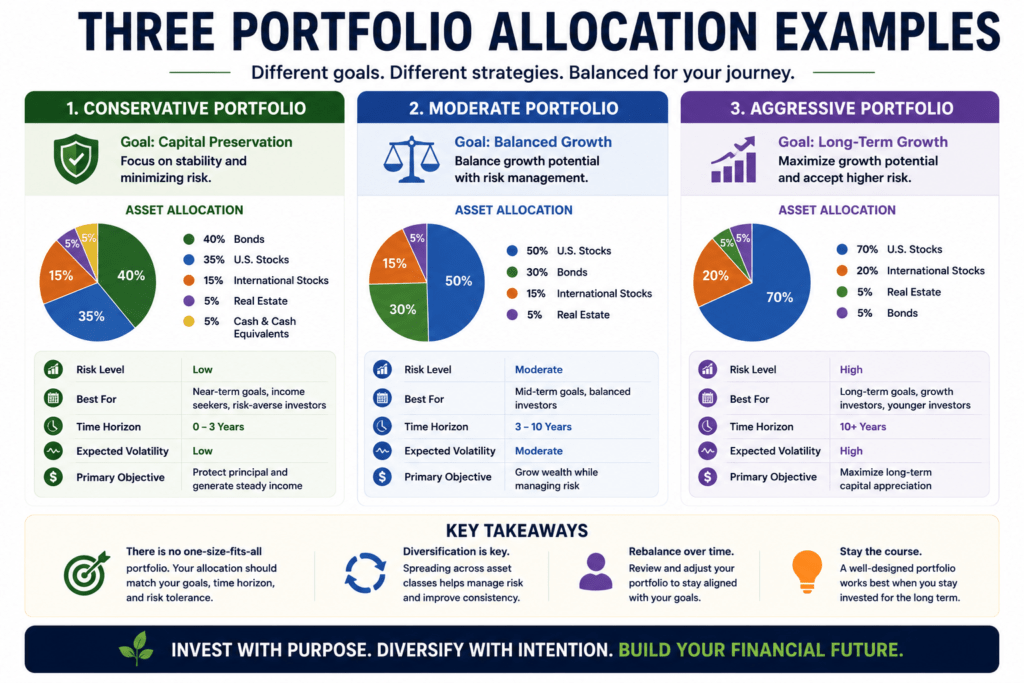
Asset allocation is one of the most powerful investment basics for managing risk and building long-term wealth.
Asset allocation refers to how investments are distributed among different asset classes.
Examples include:
- Stocks
- Bonds
- Cash
- International Investments
Why Asset Allocation Matters
Many investing experts believe asset allocation plays a larger role in portfolio performance than selecting individual investments.
A well-designed portfolio can help investors:
✔ Manage risk
✔ Improve diversification
✔ Stay disciplined
✔ Navigate different market conditions
Example Asset Allocation Models
Conservative Investor
- Stocks: 40%
- Bonds: 50%
- Cash: 10%
Moderate Investor
- Stocks: 70%
- Bonds: 20%
- Cash: 10%
Growth Investor
- Stocks: 90%
- Cash: 10%
Educational Resource
The Vanguard Investor Education Center provides excellent educational content on asset allocation and long-term investing.
How Successful Investors Think
One of the most valuable investment basics has nothing to do with stocks, ETFs, or bonds.
It has to do with mindset.
Successful investors often think differently from unsuccessful investors.
They Focus on Process
Instead of asking:
“What stock will double next month?”
They ask:
“What process can I follow for the next 20 years?”
They Think Long-Term
Long-term thinking is one of the most powerful investment basics.
Successful investors often measure progress in:
- Years
- Decades
not:
- Days
- Weeks
They Accept Uncertainty
Markets will always involve uncertainty.
Successful investors understand that uncertainty is normal.
They focus on what they can control:
✔ Savings rate
✔ Diversification
✔ Asset allocation
✔ Education
✔ Consistency
For a deeper understanding of investing psychology, read:
How to Build a Strong Investment Mindset Before You Start Investing
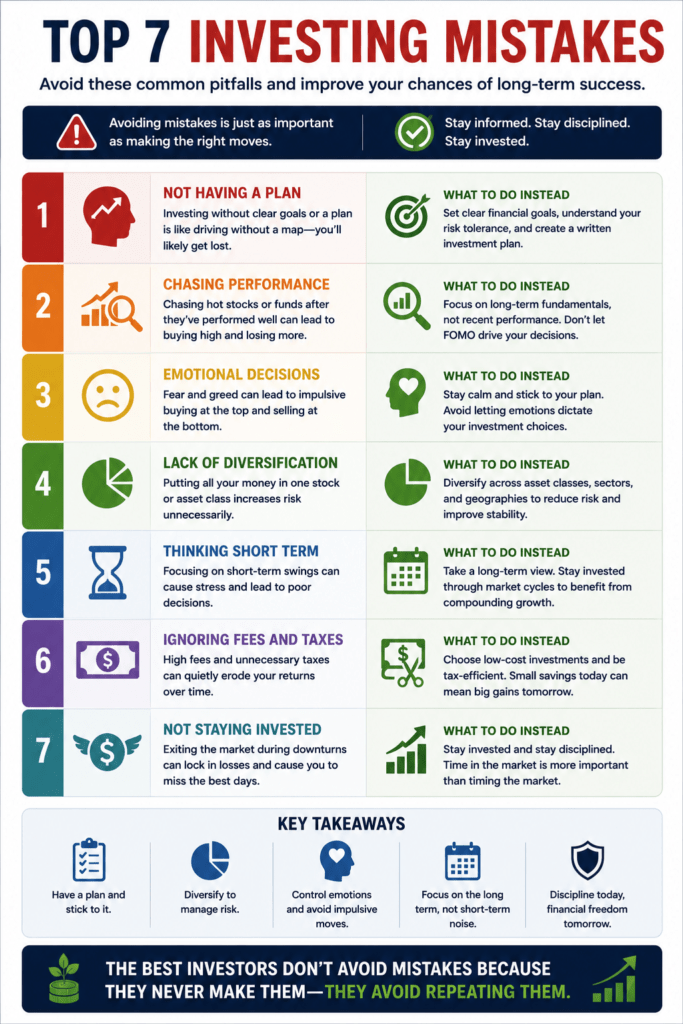
Common Beginner Investing Mistakes
Learning investment basics also means understanding what mistakes to avoid.
Mistake #1: Chasing Market Hype
Many investors buy investments simply because everyone else is talking about them.
This often leads to poor decisions.
Mistake #2: Ignoring Diversification
Concentrating too much money in a single investment increases risk.
Mistake #3: Trying to Time the Market
Predicting short-term market movements consistently is extremely difficult.
Mistake #4: Panic Selling
Fear often causes investors to sell during market declines.
This is one of the most common investing mistakes.
Mistake #5: Lack of a Plan
Without a strategy, investing becomes reactive rather than intentional.
Developing a Long-Term Investing Mindset
The final investment basic covered in this section is mindset.
Successful investing requires:
- Patience
- Discipline
- Consistency
- Continuous learning
Many investors know what to do.
Far fewer consistently do it.
Building the right mindset helps investors remain committed during both bull markets and bear markets.
This mindset often becomes a competitive advantage.
Why Investment Basics Create Better Investors
The purpose of learning investment basics is not simply to understand terminology.
The purpose is to make better decisions.
When investors understand:
✔ Stocks
✔ ETFs
✔ Bonds
✔ Risk
✔ Diversification
✔ Compounding
✔ Inflation
✔ Market cycles
✔ Asset allocation
they gain the confidence necessary to invest with greater clarity and discipline.
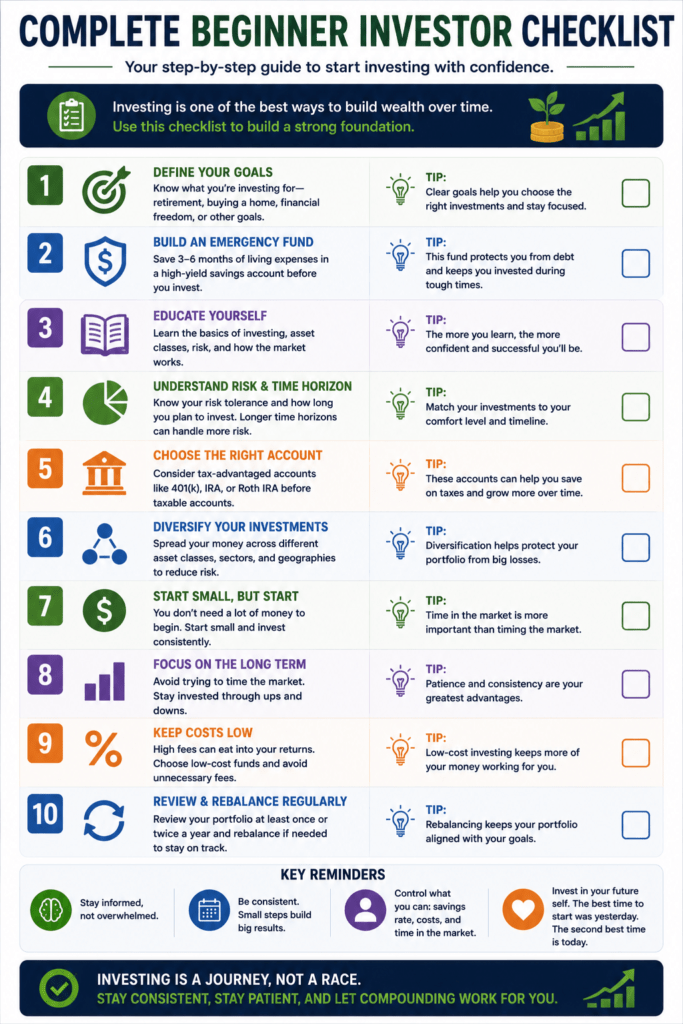
Beginner Investor Checklist
Now that you’ve learned the most important investment basics, it’s time to ensure you’re ready to take your first step into investing.
Before making your first investment, review the checklist below.
Financial Foundation Checklist
✔ I have a budget.
✔ I understand my monthly expenses.
✔ I have started building an emergency fund.
✔ I am actively managing high-interest debt.
Investment Basics Checklist
✔ I understand what stocks are.
✔ I understand what ETFs are.
✔ I understand how bonds work.
✔ I understand risk and reward.
✔ I understand diversification.
✔ I understand compound growth.
✔ I understand inflation.
✔ I understand market volatility.
Investing Mindset Checklist
✔ I have realistic expectations.
✔ I understand that markets fluctuate.
✔ I am focused on long-term investing.
✔ I have a plan for staying consistent.
Strategy Checklist
✔ I have defined my financial goals.
✔ I understand my risk tolerance.
✔ I know how much I plan to invest regularly.
✔ I have selected a basic investment strategy.
Your First Investment Action Plan
One of the biggest mistakes beginner investors make is waiting too long.
Learning is important.
However, eventually learning must lead to action.
The goal is not to start perfectly.
The goal is to start intelligently.
Step 1: Define Your Goal
Ask yourself:
Why am I investing?
Examples:
- Retirement
- Financial independence
- Wealth building
- Future financial security
A clear goal creates direction.
Step 2: Choose an Investment Account
Research the available investment platforms in your country.
Look for:
✔ Security
✔ Low fees
✔ Ease of use
✔ Educational resources
Step 3: Start Simple
Many beginner investors benefit from starting with diversified ETFs.
This approach reduces complexity and promotes diversification.
Step 4: Invest Consistently
Consistency often matters more than timing.
Many successful investors use Dollar-Cost Averaging by investing a fixed amount regularly.
Step 5: Continue Learning
Investing is a lifelong skill.
The more investment basics you understand, the more confident your decision-making becomes.
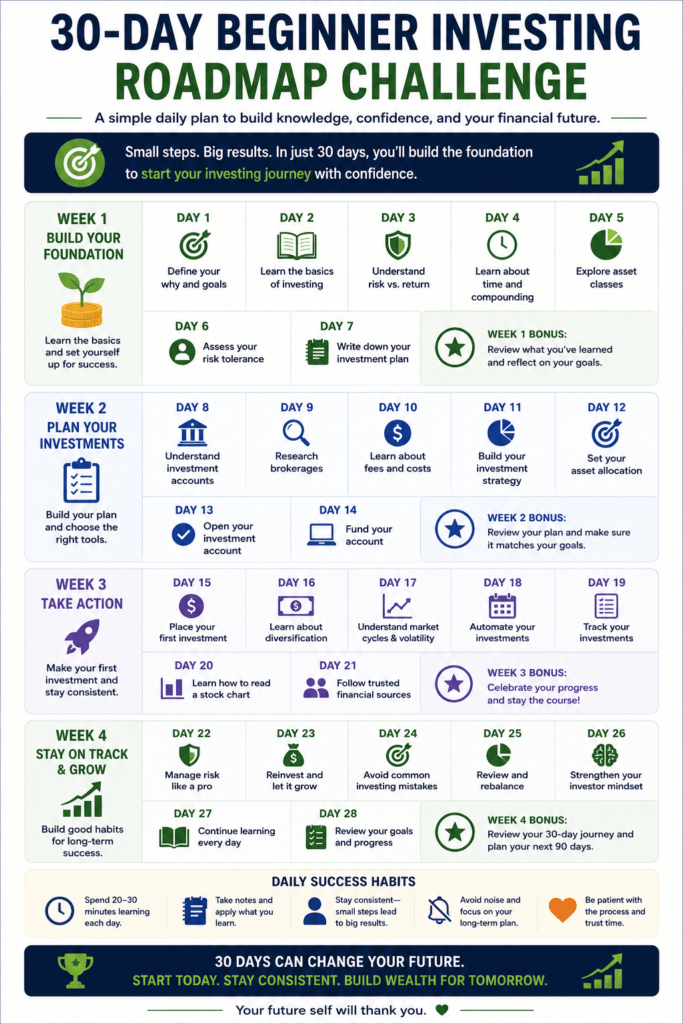
The 30-Day Beginner Investing Challenge
If you’re ready to move forward, consider following this simple challenge.
Week 1
Learn:
- Stocks
- ETFs
- Diversification
Read:
How the Stock Market Works
Stocks vs ETFs for Beginners
Week 2
Define:
- Goals
- Risk tolerance
- Investing budget
Week 3
Research:
- Investment platforms
- ETFs
- Beginner portfolio structures
Week 4
Make your first investment and create your contribution schedule.
Remember:
Small beginnings often lead to significant results.
FAQ
What are the most important investment basics for beginners?
The most important investment basics include understanding stocks, ETFs, bonds, diversification, risk management, compound growth, inflation, and long-term investing.
How long does it take to learn investment basics?
Most investors can learn the core investment basics within a few weeks of focused study. However, investing is a lifelong learning process.
Can I start investing with a small amount of money?
Yes. Many investment platforms allow investors to start with relatively small amounts. Consistency often matters more than the initial amount invested.
Should beginners invest in individual stocks?
Many beginners choose to start with diversified ETFs before investing in individual stocks.
Why is diversification important?
Diversification helps reduce risk by spreading investments across multiple assets rather than relying on a single investment.
What is the biggest investing mistake beginners make?
One of the most common mistakes is delaying action while waiting for perfect conditions.
How does compound growth help investors?
Compound growth allows investment returns to generate additional returns over time, creating a powerful long-term wealth-building effect.
What should I learn after mastering these investment basics?
The next step is learning more advanced topics such as investment strategies, portfolio construction, investor psychology, and wealth building.
Final Thoughts
Every successful investor starts at the same place:
The beginning.
No one is born understanding stocks, ETFs, diversification, or asset allocation.
These skills are learned.
The purpose of this guide was to provide the investment basics every beginner investor should understand before making their first investment.
By mastering these investment basics, you place yourself in a stronger position to:
✔ Make informed decisions
✔ Avoid common mistakes
✔ Stay disciplined
✔ Build confidence
✔ Create long-term wealth
Remember:
Investing success rarely comes from predicting the future.
It comes from understanding the fundamentals, following a strategy, and remaining consistent over time.
Start small.
Keep learning.
Stay patient.
And allow your knowledge and investments to grow together.
Want More Beginner Investing Education?
Join the InvestSmartEdge newsletter and receive:
✔ Beginner investing guides
✔ Investment strategy tutorials
✔ Wealth-building insights
✔ Market education
✔ AI investing tools and reviews
✔ Long-term investing tips
directly in your inbox.
FREE FIRST PORTFOLIO BLUEPRINT
No spam.
Author:
Mario Cazombo
Mario Cazombo is the founder of InvestSmartEdge and a financial education writer focused on helping beginner investors build wealth through education, strategy, investor psychology, and smart investing tools.
His mission is to simplify investing and provide practical guidance that helps people build confidence and long-term financial success.
Disclaimer
Invest Smart Edge provides educational content for informational purposes only and does not provide investment, legal, tax, or financial advice.
All investments involve risk, including the possible loss of principal. Past performance does not guarantee future results.
Always conduct your own research and consider consulting a qualified financial professional before making investment decisions.